Ask a cybersecurity student to list common web vulnerabilities, and you’ll likely get a confident, well-rehearsed answer. Ask them to find one in a running application they’ve never seen before, and the confidence often evaporates. That distance — between naming an attack and stopping it — is the central problem in how we teach security today.
Recall is not a skill
Memorization has its place. You need vocabulary to communicate, and a mental map of the landscape to orient yourself. But security is an applied, adversarial discipline. Attackers don’t follow the textbook; real systems are messy, and the interesting problems live in the gap between what should happen and what actually does. A student who has memorized “cross-site scripting: injection of malicious scripts” has a definition. They cannot yet work out why a perfectly sanitized note still manages to execute code.
Why memorization fails in security
In some fields, recall carries you a long way. Security isn’t one of them, for three reasons. Adversaries adapt, so yesterday’s checklist is today’s blind spot. Real systems are noisy and incomplete, nothing like the clean diagrams on the slides. And defense is fundamentally judgment under uncertainty — knowing what to investigate first when ten things look slightly wrong. None of that comes from flashcards. It comes from repetition against realistic problems.
The shift: a practice loop
The fix is to reorganize learning into a loop rather than a lecture. A student meets a real, broken system. They attempt something. It fails — and the failure teaches them what the slide never could. They adjust, try again, and eventually break through. That hard-won understanding is the part that sticks.
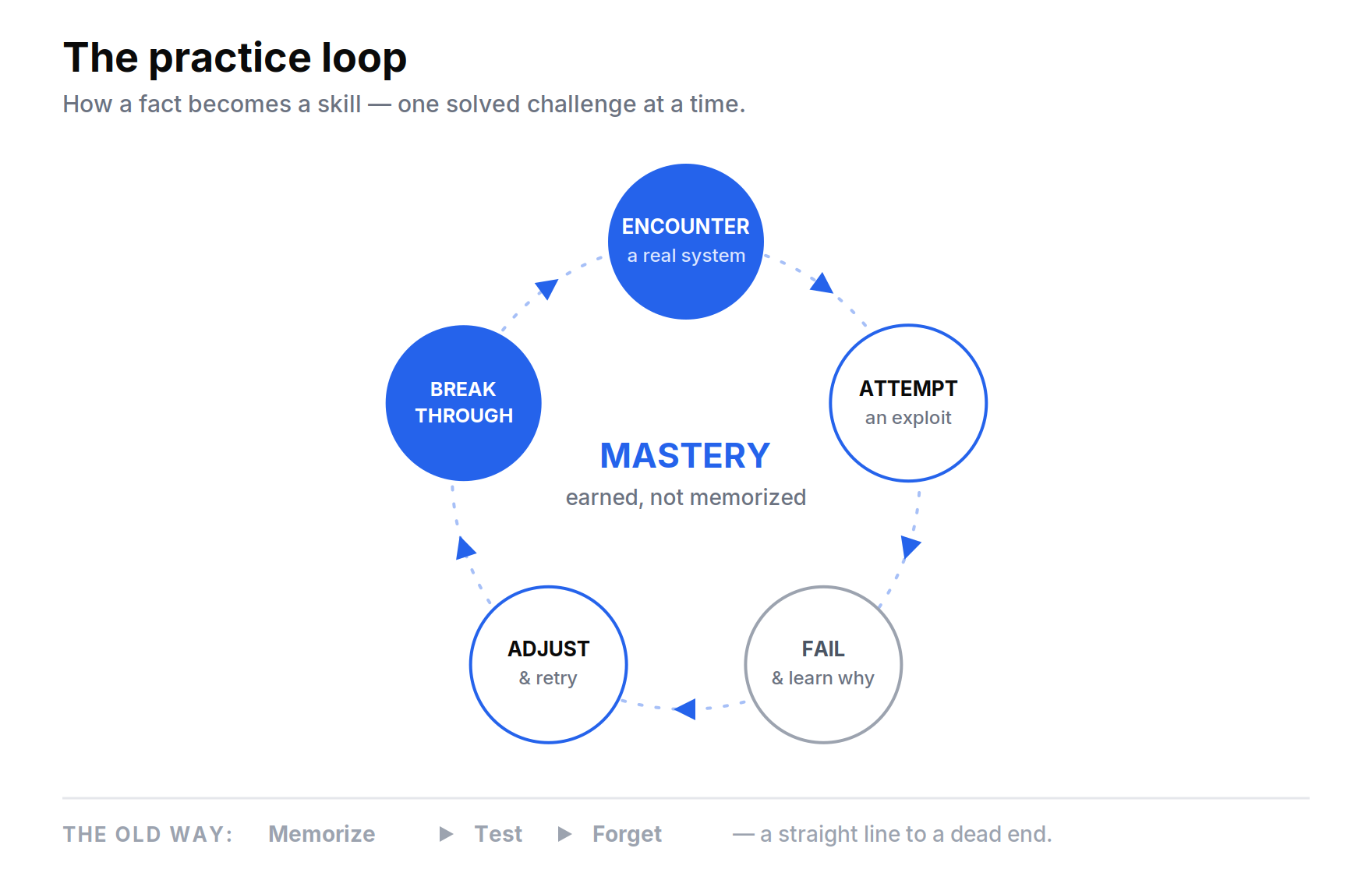
A lecture is a straight line that ends in forgetting. Practice is a loop that ends in capability.
This is where scenario-based learning earns its keep. Instead of describing an attack, you hand the student the system and let them work it. On our platform, a learner can wrestle with PoisonedNote — a note-taking app that sanitizes input correctly yet remains exploitable — pushing them beyond the definition of XSS and into how it actually behaves. They can turn a “boring” health-check service into a remote shell by noticing what the app does with their input before the business logic ever sees it. Or they can build a targeted wordlist from leaked personal details and crack a password hash the way a real attacker would.
Each challenge swaps a fact for an experience. The student doesn’t just know that insecure deserialization can be dangerous — they’ve used it to get a shell, and they won’t forget what that felt like.
What this means for instructors
Teaching this way sounds harder than lecturing. It doesn’t have to be. A ready-made library of challenges removes the prep work, and tools like Simulations Copilot help generate and manage content, so professors spend their time coaching instead of building infrastructure. Setting up a class competition becomes a matter of launching a CTF, not standing up servers.
And if you want a structured way to make the shift, the University Cyber Cup gives universities a three-month, fully supported path from a first guided competition to running events entirely on their own.
The goal of security education was never to produce graduates who can describe attacks. It’s to produce people who can stop them. That means trading some lecture time for lab time — and letting students learn the way the work is actually done.
| Stop teaching attacks. Start letting students stop them. Explore the scenario library, or bring a supported Capture the Flag program to your university. Explore Scenarios → Bring It to Campus → |
|---|