Adversarial actors now leverage automated vulnerability scanners, polymorphic payload generators, and synthetic spear-phishing campaigns that execute in seconds. In response, modern defense operations cannot rely on annual thirty-minute slide presentations or multiple-choice compliance quizzes.
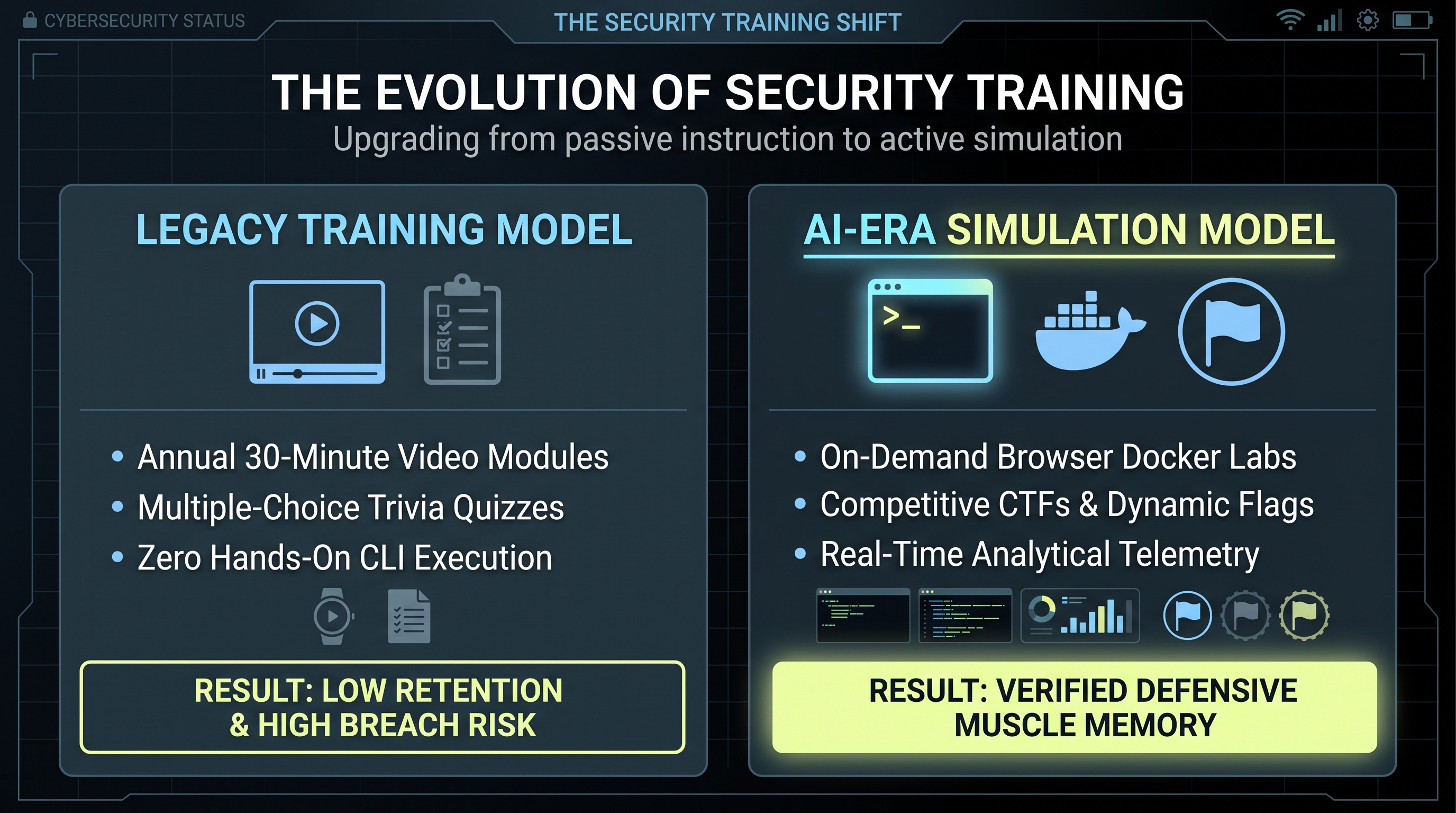
When an incident response team faces an automated exploit chain, theoretical knowledge provides zero defensive velocity. Security personnel need intuitive command-line fluency, live threat triage experience, and muscle memory developed under operational stress. To build defensive resilience, enterprise organizations must rethink their workforce development and adopt modern cybersecurity training in the age of AI centered around ephemeral, containerized simulation environments and gamified technical scenarios.
The Reality Check: Why Legacy Training Fails Modern Teams
Traditional corporate training models fail to address modern threat vectors due to three structural weaknesses:
- Static Scenarios vs. Dynamic Attacks: Traditional courseware is updated on annual cycles, leaving teams unprepared for zero-day vulnerabilities, model evasion, and prompt injection attacks that iterate weekly.
- Absence of Tool Fluency: Passive video watching does not teach an analyst how to navigate a SIEM under load, analyze raw packet captures, or inspect malicious Docker runtime configurations.
- No Verification of Practical Competence: Multiple-choice exams verify memorization, not execution. A passing grade does not demonstrate whether an engineer can isolate a compromised cloud workload during an active breach.
3 Pillars of Modern Cybersecurity Training
Preparing defensive teams for automated, intelligent threats requires an active, adversarial training model built on three foundational capabilities:
1. Browser-Based, Containerized Sandboxes
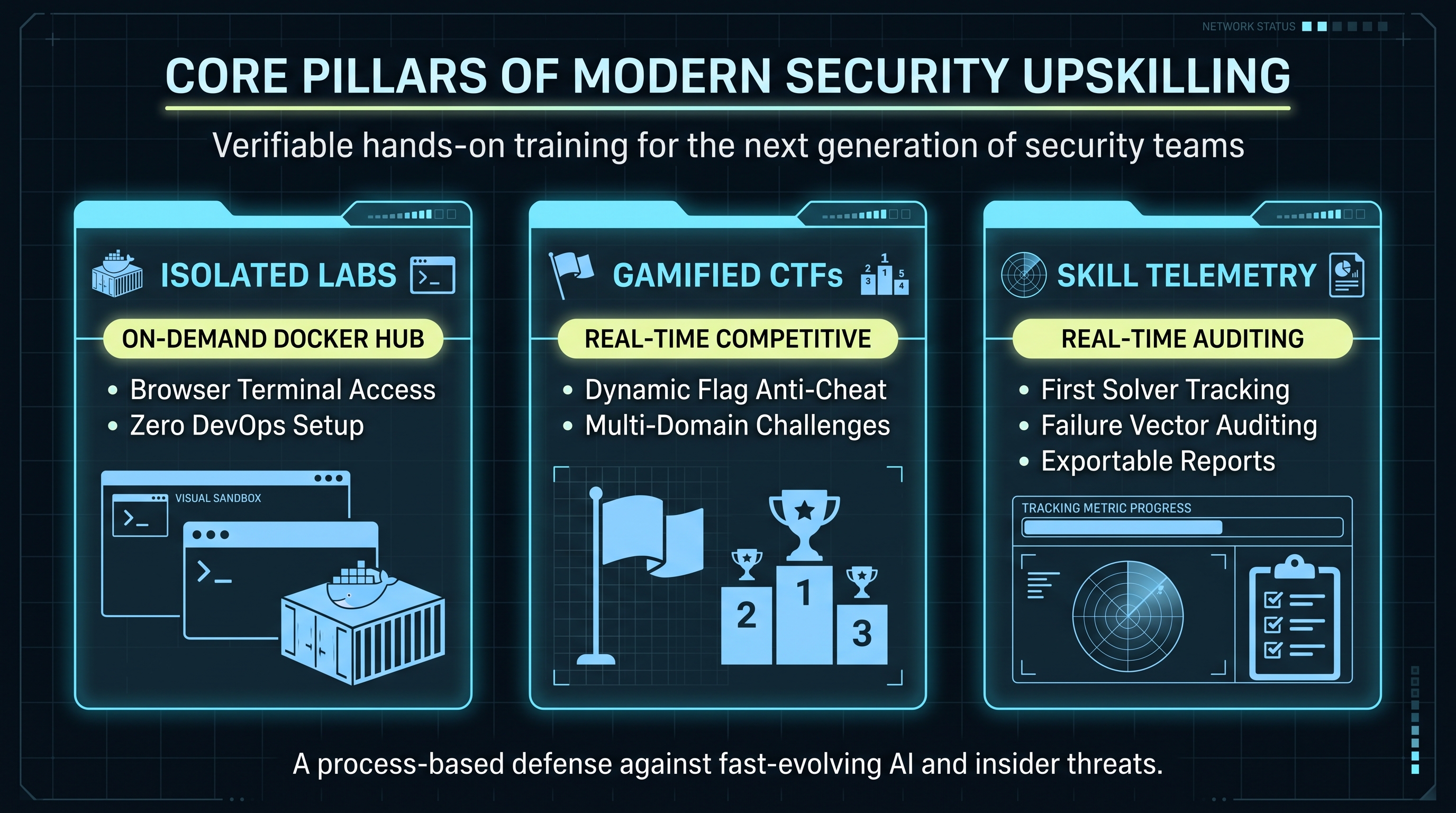
Training environments must mirror production complexity without exposing corporate assets to operational risk. By leveraging on-demand Docker containers, organizations can provide analysts with isolated, authentic operating systems accessible directly in a web browser. Analysts can dissect malicious network traces, inspect suspicious binaries, and harden web applications without configuring local virtual machines or manual VPN tunnels.
2. Gamified Capture the Flag (CTF) Challenges
Capture the Flag competitions convert passive upskilling into active, competitive exercises. When engineers compete on live leaderboards to uncover flags, analyze traffic, and solve security puzzles across Web Security, OSINT, Digital Forensics, and Reverse Engineering, engagement and knowledge retention increase significantly. Implementing dynamic flags—cryptographically distinct keys issued per participant—prevents answer-sharing and preserves evaluation integrity.
3. Real-Time Telemetry and Gap Analysis
Effective upskilling requires diagnostic visibility. Modern training engines must capture granular telemetry: tracking first-solver benchmarks, logging repeated incorrect submissions, and identifying conceptual roadblocks across the defensive roster. These analytics reveal whether an engineering team struggles with network forensics, cloud identity privilege escalations, or API vulnerabilities.
Legacy Training vs. AI-Era Simulation Training
| Dimension | Legacy Corporate Training | Modern Simulation Labs |
|---|---|---|
| Delivery Medium | Slide decks, video tutorials, multiple-choice tests | Browser-based, on-demand Docker containers |
| Evaluation Standard | Completion badges, theoretical scores | Dynamic flag captures, time-to-containment |
| Integrity Controls | Unmonitored, open-book questionnaires | Randomized dynamic flags, command telemetry |
| Operational Relevance | Outdated CVEs, generic compliance rules | Real-world threat vectors, live application code |
| Infrastructure Overhead | High LMS maintenance, static content | Fully managed SaaS orchestration, zero server setup |
Step-by-Step: Implementing an Internal Training Pipeline
- Map Challenges to the NICE Framework: Align training modules with defined Task, Knowledge, and Skill (TKS) statements from the NIST NICE Framework so exercises directly mirror specific job roles (such as SOC Analyst or Incident Responder).
- Deploy Role-Specific Exercises: Utilize automated platforms to launch role-tailored challenge environments. Organizations can host internal CTF competitions to test employees against diverse domains, including Cryptography, Network Analysis, and System Forensics.
- Integrate AI Copilots for Dynamic Challenge Creation: Rather than spending months authoring complex labs from scratch, training leaders can leverage AI-assisted creation engines to generate custom technical challenges on demand, allowing non-technical managers to launch scenario labs in minutes.
- Benchmark with Hands-On Assessments: Evaluate new team members using hands-on skill assessment environments to verify candidate capabilities before placing them into production rotations.
Scaling Practical Training Without Infrastructure Overhead
A common challenge for enterprise engineering teams is the operational overhead of running internal labs. Managing virtual machines, orchestrating Kubernetes pods, configuring egress firewall filters, and monitoring server uptime consume hundreds of DevOps hours.
Using a fully managed SaaS platform like Simulations Labs eliminates this technical burden. The platform automatically orchestrates container isolation, security, scaling, and scoring, allowing security leaders to focus entirely on curriculum development and skill evaluation.
Reviewing published enterprise simulation case studies highlights how companies use automated sandboxes to upskill existing personnel and identify critical operational talent.
5 Best Practices for Building an AI-Resilient Team
- Train Continuously, Not Annually: Run micro-simulations monthly rather than hosting single annual workshops to ensure steady skill progression.
- Incorporate Adversarial Emulation: Expose defensive personnel to attack methodologies cataloged in the MITRE ATT&CK Framework to teach them how threat actors bypass modern detection controls.
- Cross-Train Technical and Non-Technical Teams: Use gamified competitions to introduce foundational security concepts to software developers, DevOps engineers, and IT administrators.
- Measure Analytical Reasoning, Not Just Speed: Evaluate write-ups and diagnostic methodologies alongside scoreboard rankings to confirm genuine understanding.
- Simulate AI-Specific Attack Vectors: Include exercises focused on emerging risks from the OWASP Top 10 for LLMs, such as indirect prompt injection and insecure plugin executions.
Organizations seeking to upgrade their workforce capabilities can deploy containerized simulation environments in minutes with zero server configuration. Browse our practical technical cybersecurity guides or schedule a live platform demonstration to see how Simulations Labs prepares teams for emerging threats.
3. Frequently Asked Questions
Q: Why is hands-on cybersecurity training essential in the age of AI?
Adversarial actors use AI to automate exploit discovery and accelerate attack execution. Defending against these threats requires practical command-line proficiency, real-time log triage, and defensive muscle memory that cannot be developed through static lectures or multiple-choice questions.
Q: What is an enterprise Capture the Flag (CTF) competition?
An enterprise CTF is a gamified cybersecurity training exercise where employees solve hands-on technical challenges—such as analyzing network traffic or identifying application vulnerabilities—to discover cryptographic flags and earn points on a real-time leaderboard.
Q: How do containerized labs improve training security?
Containerized labs isolate each challenge inside an ephemeral Docker instance. Participants interact with live, vulnerable software in an isolated environment that is automatically destroyed upon task completion, preventing cross-contamination and protecting corporate networks.
Q: How do dynamic flags stop participants from sharing answers?
Dynamic flag engines generate unique, randomized cryptographic tokens for each individual user session. Even if two analysts solve the same challenge, their flag strings differ, preventing answer sharing and ensuring accurate skill evaluation.
Q: How often should enterprises run technical simulation exercises?
High-performing security organizations run focused technical micro-labs monthly and conduct larger team-based simulations or internal CTFs quarterly. Regular practice maintains operational readiness far more effectively than annual training marathons.
Q: Does hosting technical simulations require a dedicated DevOps team?
No. Modern cloud-native platforms like Simulations Labs automate container deployment, dynamic flag validation, server monitoring, and scoring, allowing organizations to launch hands-on events without manual server management.