Introduction
In the rapidly changing world of cyber threats, the common training and education approaches tend to lack the effectiveness of ensuring that learners remain engaged and that there is a relevant skill set development that takes place.
Gamification applying to non-game contexts has emerged as a powerful approach to enhance cybersecurity learning outcomes.
For educators, security teams, and hiring managers, leveraging gamified experiences such as capture-the-flag (CTF) competitions, cyber drills, and cyber ranges creates more effective, memorable, and measurable training.
Why gamification works for cybersecurity education
Gamification taps into motivation, engagement, and retention by turning learning into an active, goal-oriented experience.
Key psychological drivers include clear goals, immediate feedback, progressive difficulty, and social competition elements naturally present in CTFs and simulated cyber drills hosted on modern cyber ranges.
- Active learning: Gamified exercises force learners to apply concepts rather than passively consume information.
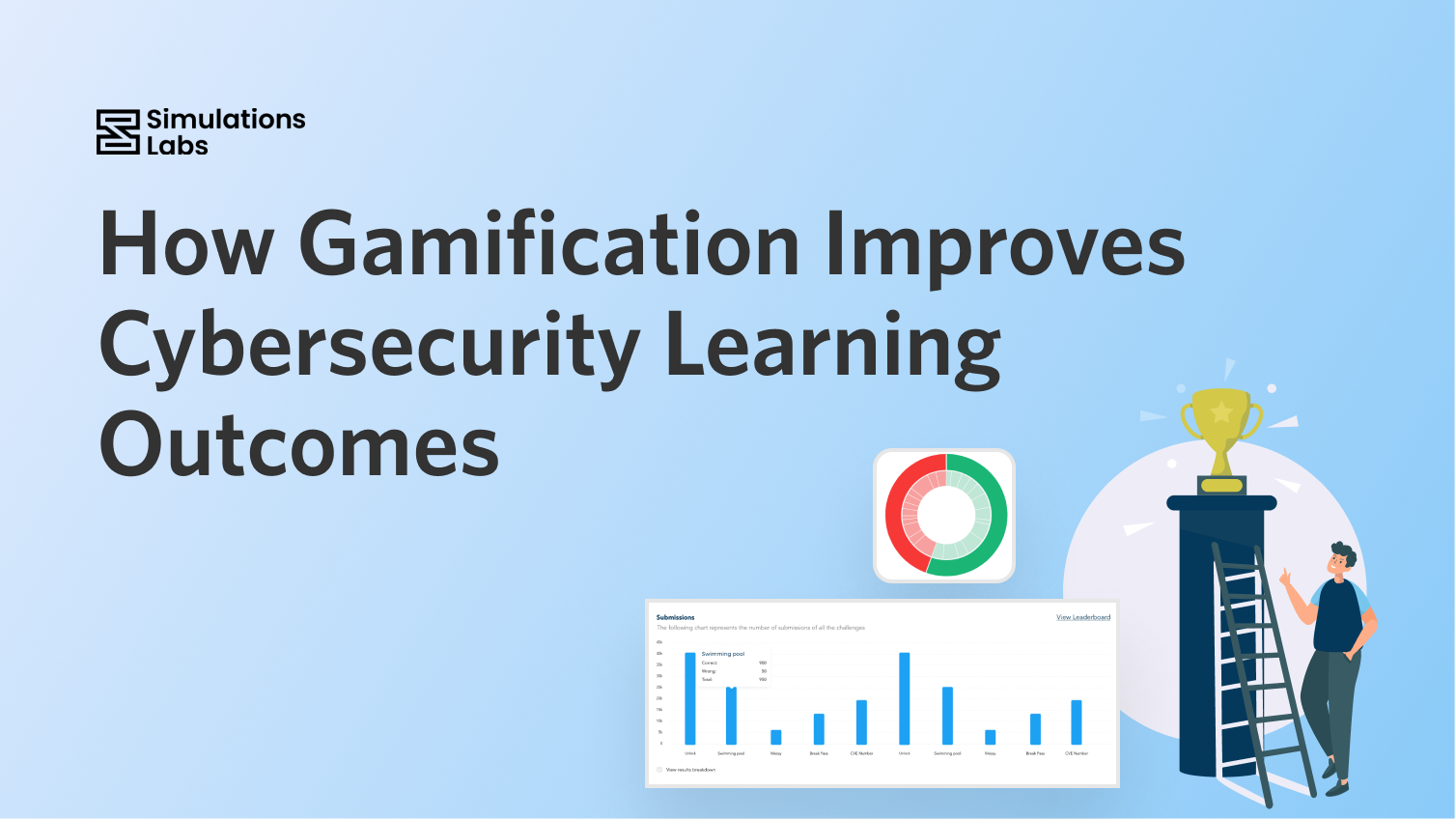
- Immediate feedback: Dynamic scoring, live leaderboards, and challenge success/failure provide instant performance cues that accelerate learning loops.
- Safe failure: Simulated environments let participants fail and retry without real-world consequences, which is essential for complex cybersecurity skills.
- Motivation and engagement: Competition, badges, and rankings increase participation and course completion.
Core gamified formats used in cybersecurity
Different formats emphasize different skills. A robust training program will combine multiple approaches.
- CTF competitions: Capture-the-Flag events are puzzle-driven challenges that teach vulnerability discovery, exploitation, reverse engineering, forensics, web security, and more.
- Cyber ranges: Environments that emulate networks and infrastructure for hands-on exercises and incident response drills.
- Cyber drills and tabletop exercises: Scenario-based exercises, often used for incident response rehearsals, that build procedural and team coordination skills.
How gamification improves specific learning outcomes
1. Faster skill acquisition
Gamified tasks break complex skills into manageable challenges. In a CTF host environment, each challenge targets a specific competency (e.g., SQL injection or memory forensics). Learners can repeatedly attempt tasks and receive immediate scoring feedback, which accelerates the transition from theory to applied competence.
2. Better knowledge retention
Spacing, repetition, and retrieval practice are proven cognitive strategies for retention. Gamified platforms naturally incorporate these through progressive challenge sets, leaderboards that encourage revisiting tasks, and downloadable reports that enable instructors to assign remedial exercises for weak areas.
3. Realistic decision-making under pressure
Timed competitions and live cyber drills create urgency that simulates real incident response conditions. Participants practice prioritization, time management, and stress-resilient problem-solving skills that traditional classroom lectures rarely develop.
4. Measurable assessment and analytics
One of the biggest advantages of modern gamified platforms is analytics. Teams and instructors gain insights such as time-to-solve, most-failed challenges, first-solver metrics, and per-participant progress. These metrics help tailor follow-up training and objectively measure improvement.
Design best practices for gamified cybersecurity learning
To maximize impact, follow instructional design principles when creating cyber drills, CTFs, or exercises on a cyber range.
- Align challenges to learning objectives: Begin with clear outcomes (e.g., detect phishing, perform memory analysis) and design challenges that map directly to those objectives.
- Use progressive difficulty: Start with fundamentals and escalate complexity to maintain engagement and build confidence.
- Provide scaffolding: Offer hints, walkthroughs, or debrief sessions so learners can reflect on mistakes and understand correct approaches.
- Mix assessment and practice: Separate formative (practice) from summative (assessment) events to reduce anxiety and encourage experimentation.
- Promote collaboration: Team-based challenges mirror workplace dynamics and build communication and role-based skills.
Case: How Simulations Labs applies gamification at scale
Simulations Labs is a no-code platform that enables organizations, universities, and instructors to build and launch cybersecurity simulations, CTFs, cyber drills, and cyber ranges without technical overhead. With over 15 years of experience running CTFs, Simulations Labs understands what motivates learners and how to structure challenges for real learning outcomes.
Key features that drive results:
- No-code CTF hosting: Quickly create and launch a CTF without needing developers or DevOps.
- AI challenge creation: Use AI to create challenges that are aligned with your specific learning or assessment goals.
- Custom challenge creation: On-demand labs, downloadable labs, and dynamic flag challenges ensure fairness and create varied practice opportunities.
- Live leaderboards and analytics: Track team and individual performance in real time, then export reports (CSV, Excel, PDF) for training evaluation.
- Targeted participant prerequisites: Set filters by university, country, or demographics to create inclusive or focused events.
Practical examples and templates
Here are three quick templates to implement gamified learning:
- Onboarding CTF for new hires: A two-week series of progressive challenges covering company security policy, secure coding basics, and incident reporting. Use a private cyber range and end with a live leaderboard presentation.
- University skills ladder: Semester-long CTF series with weekly challenges that map to course modules. Allow downloadable labs for offline analysis and use analytics to grade participation and competency.
- Tabletop-to-Range drill: Start with a tabletop scenario, then escalate to an active cyber drill on a simulated network to practice incident response workflows and communication under pressure.
Measuring ROI for gamified cybersecurity programs
To demonstrate value, track both quantitative and qualitative metrics:
- Pre/post assessments: Measure technical competency before and after training.
- Time-to-detect and time-to-contain: Use cyber range exercises to measure improvement in response times.
- Participation and completion rates: Gamified formats typically boost attendance and completion, and track these to justify budgets.
- Behavioral change: Monitor phishing click rates, patching compliance, or incident reporting as downstream indicators of training effectiveness.
Common pitfalls and how to avoid them
- Overemphasis on competition: Too much focus on winning can discourage novices. Balance leaderboards with collaborative tracks and achievement badges.
- Poor alignment to objectives: Gamified tasks must map to real skills; avoid gimmicky challenges that don't translate to workplace competence.
- Insufficient debrief: Failure without feedback reduces learning. Always follow games with debriefs, writeups, or guided walkthroughs.
Conclusion
Gamification implemented through cyber drills, cyber ranges, and CTF competitions offers a scalable, measurable, and engaging path to improve cybersecurity learning outcomes.
Platforms like Simulations Labs remove the technical friction from building and hosting these experiences, enabling educators, employers, and community organizers to focus on high-quality instructional design and learner experience.
Ready to bring gamified cybersecurity training to your organization? Start by exploring Simulations Labs’ hosting options: Host CTF Competition