In late 2025, an AI developer disclosed something security teams had mostly discussed as a future scenario: a threat actor had used its models to automate somewhere between 80% and 90% of the effort in an active intrusion campaign, with a human directing only a handful of the actual steps. By 2026, that stopped being an isolated disclosure and became a pattern, incident after incident where an AI agent did the work a trained human operator used to do: writing exploit code, running reconnaissance, deciding in real time when to escalate.
The uncomfortable part for anyone running defender training isn't that this happened. It's that most SOC training programs are still built around a threat that moves at human speed, against attacks that increasingly don't.
-
The Timeline Problem
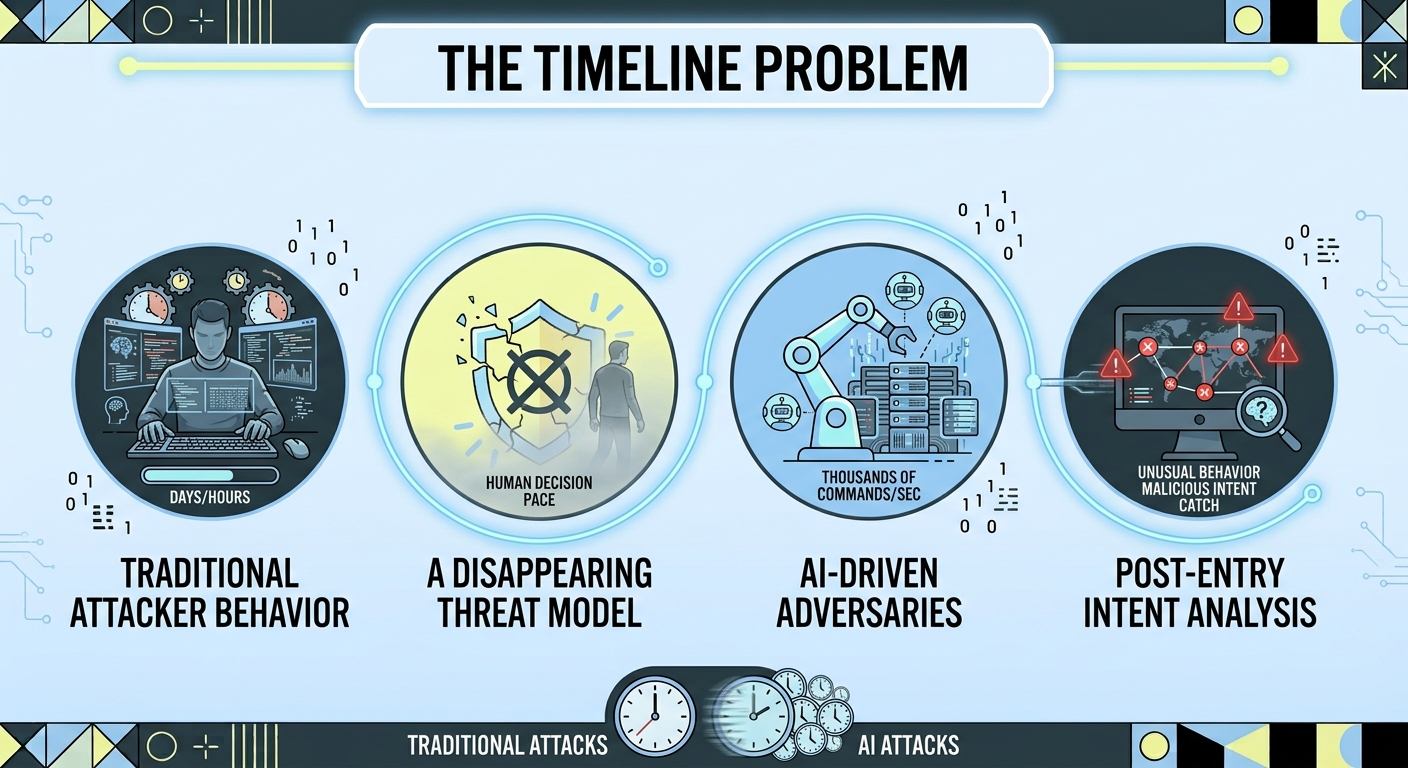
Traditional attacker behavior, however sophisticated, was bounded by how fast a person could type, pivot, and make decisions. Training built around that assumption teaches defenders to expect a certain rhythm: reconnaissance over days, lateral movement over hours, a decision point where a human analyst has time to notice something is wrong.
That rhythm is breaking down. Attacks that used to take weeks are now compressing into minutes, with AI-driven adversaries executing thousands of commands in seconds, adapting live to error messages, and running parallel attack workflows against multiple targets at once. A defender trained to catch a slow, deliberate intrusion is trained for a threat model that's disappearing. Traditional security tools verify static credentials rather than analyzing malicious post-entry intent, built to check identity, not to catch the kind of unusual behavior an AI-driven attacker produces once it's already inside.
-
The Real Bottleneck Isn't Budget
It would be easy to assume this is a tooling problem: buy better detection software, deploy an AI-native SOC platform, solve it with a bigger line item. The data doesn't support that read. Industry research on this consistently ranks insufficient knowledge and experience with AI-driven threats above budget as the top barrier defenders actually face, you can't purchase your way out of a skills gap.
That gap is already wide before AI attackers entered the picture. ISC2's 2025 workforce study puts the number of organizations reporting a cybersecurity skills gap at 95%, with 59% facing what they classify as a critical or significant shortage of skilled professionals. Layer machine-speed, AI-driven attacks on top of a workforce that was already stretched thin, and the gap doesn't just persist; it compounds.
There's also a quieter, more specific version of this problem worth naming: the people closest to the actual tools are the most skeptical of them. Only about a quarter of hands-on security operators strongly agree that AI tools are improving their work, compared to well over half of the executives evaluating those same tools from further away. Training that ignores this gap, that assumes analysts will trust and effectively use AI-assisted detection just because leadership purchased it, is training for an org chart, not for how defense actually happens on the floor.
-
What Defender Training Actually Needs to Change
1. Train for compressed decision cycles, not just accurate detection. Knowing what a lateral movement pattern looks like matters less if a trainee has never practiced recognizing and acting on it inside a window of minutes instead of hours. Training environments need to compress timelines deliberately, timed, live scenarios rather than untimed tabletop walkthroughs, so the muscle memory being built matches the actual pace of what defenders are up against.
2. Teach the specific behavioral signature of AI-driven attacks. An AI-orchestrated intrusion doesn't just move faster; it behaves differently. Parallelized reconnaissance across many targets at once, real-time adaptation to defensive responses, and polymorphic payloads that shift to evade signature-based detection are patterns worth training analysts to recognize specifically, rather than assuming general intrusion-detection training automatically covers them.
3. Build genuine "assume breach" instincts, not just perimeter vigilance. Since AI-driven attackers are shown to bypass identity and credential checks efficiently, the more durable skill is recognizing anomalous behavior after something has already gotten past the front door: unusual data movement, irregular access patterns, behavior that doesn't match a legitimate user even when the credentials check out.
4. Practice working alongside AI tools, not just against AI attackers. Agentic SOC platforms are becoming standard equipment on the defensive side too, and the skill of knowing when to trust an AI copilot's triage recommendation versus when to override it is now as real a training need as recognizing an attacker's TTPs. Analysts who've never practiced this collaboration under pressure are more likely to either over-trust a flawed suggestion or ignore a correct one, both costly failure modes.
5. Make training recurring and realistic, not annual and abstract. A yearly tabletop exercise built around last year's threat patterns is already outdated by the time it runs. Given how fast AI-driven attacker tooling is evolving, defender training needs the same update cadence, live, current, hands-on scenarios refreshed regularly, not a static curriculum revisited once a year.
-
Building This Into an Actual Program
None of this is achievable through lecture-based awareness training alone; recognizing a compressed, AI-driven attack chain under time pressure is a practiced skill, not a memorized fact. This is exactly where realistic, hands-on environments earn their keep: live labs spanning Network Security, Digital Forensics, and Malware Reverse Engineering give defenders repeated, timed practice against the kind of fast-moving, multi-stage scenarios that increasingly define real incidents, rather than a single static exercise revisited once a year. For organizations building this out at scale, a university security program or a SOC hiring pipeline evaluating candidates against this new bar, the same hands-on model extends naturally into both structured training programs and candidate assessment, where the question isn't whether someone studied the material, but whether they can actually keep pace with what they're now up against.
Want to see whether your SOC team can keep pace with a machine-speed attack? Try Simulations Labs and put your defenders' response time to an actual test.
-
FAQ
Is AI actually being used to carry out real cyberattacks today, or is this mostly theoretical? It's real and documented. In late 2025, an AI developer publicly disclosed that a threat actor had used its models to automate the majority of an active intrusion campaign, and multiple 2026 incident reports describe AI agents independently writing exploit code and running reconnaissance during real breaches. This is an active, ongoing shift, not a future hypothetical.
Do we need to replace our entire SOC training program, or just add an AI module? Bolting on a single "AI threats" module isn't enough on its own, because the core issue is pacing and behavior recognition, not just awareness that AI attacks exist. The more effective approach folds AI-driven attack patterns and compressed timelines into existing hands-on training, timed, live scenarios rather than a standalone lecture.
Is this really a skills problem rather than a tooling problem? The evidence points that way. Industry surveys consistently rank insufficient knowledge and experience with AI-driven threats above budget as the top barrier organizations face, and a documented gap exists between how much executives trust AI security tools versus how much the analysts actually using them do. Better tools without better-trained people to use them tend to underperform.
How often should defender training be refreshed given how fast AI attacker tooling is changing? More often than an annual cycle. Because AI-driven attacker tooling shifts quickly, a training program refreshed once a year is often already behind by the time it runs. Recurring, live scenario updates, quarterly or more frequently for fast-moving categories, keep pace better than a static annual exercise.
What's the difference between training analysts to detect AI attacks and training them to work with AI defensive tools? They're related but distinct skills. Detecting an AI-driven attack means recognizing its behavioral signature, speed, parallelism, and adaptive evasion. Working effectively with AI-assisted SOC tools means knowing when to trust an AI copilot's triage recommendation and when to override it. A well-rounded program needs to build both, since most modern SOCs now face AI on both sides of the fight.