If you've spent any time in cybersecurity circles, you've probably heard the terms 'red team' and 'blue team' thrown around. They sound like something out of a military war game — and honestly, that's not far off. The concepts are borrowed directly from military training exercises, where opposing forces would simulate attack and defense scenarios to sharpen real-world skills.
In cybersecurity, it works the same way. One group tries to break in. The other tries to stop them. Both are on your side — and both are essential to building a resilient security posture.
But here's the thing: a lot of organizations understand the concept without actually training for it properly. This post breaks down what each team does, where they differ, and — most importantly — how you build real skill in both.
What Is a Red Team?
The red team plays the role of the attacker. Their job is to think and act like a real threat actor — probing your systems, finding weaknesses, and exploiting them before someone else does.
This goes well beyond running a vulnerability scanner. A mature red team operation involves:
-
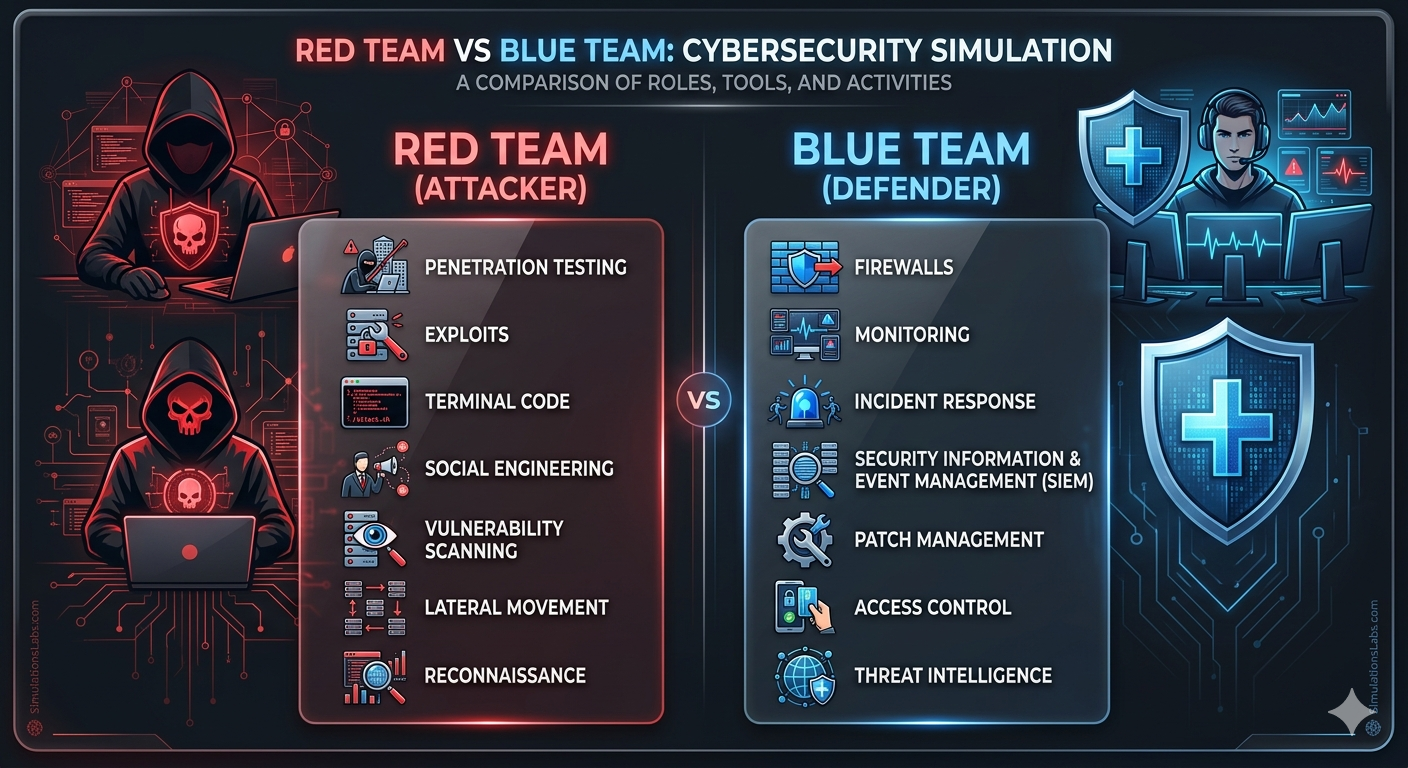
Reconnaissance — gathering intelligence on targets (employees, systems, infrastructure), the same way a real attacker would
-
Social engineering — crafting phishing emails or pretexting scenarios to manipulate people into giving up access
-
Exploitation — actively exploiting vulnerabilities in software, networks, and configurations
-
Lateral movement — once inside, moving quietly through systems to escalate privileges and reach high-value assets
-
Persistence — establishing footholds that survive reboots and detection attempts
The goal isn't just to 'find bugs.' It's to simulate the full chain of how a real attacker would compromise your environment — from the first email to a domain admin shell.
| 💡 Key distinction: A penetration test is a focused, scoped engagement. A red team operation is a full adversary simulation — stealthier, longer, and designed to test your detection and response capabilities, not just your patching hygiene. |
|---|
What Is a Blue Team?
The blue team is your defense. They're the people monitoring your environment, responding to alerts, investigating suspicious activity, and working to keep attackers out — or catch them when they get in.
Blue team responsibilities typically include:
-
Security monitoring — watching logs, alerts, and network traffic for signs of malicious activity
-
Incident response — investigating and containing security events when they occur
-
Threat hunting — proactively searching for hidden threats that haven't triggered alerts yet
-
Hardening — implementing controls, patches, and configurations that reduce the attack surface
-
Detection engineering — building and tuning detection rules so the right things get flagged
A good blue team isn't reactive — they're constantly improving. They study how attackers operate and adjust their defenses accordingly. That means understanding the red team's playbook almost as well as the red team does.
The Key Differences, Side by Side
| 🔴 Red Team | 🔵 Blue Team | |
|---|---|---|
| Role | Attacker (simulated) | Defender |
| Mindset | How do I get in? | How do I detect and stop this? |
| Primary tools | Metasploit, Cobalt Strike, custom scripts | SIEM, EDR, firewall, threat intel |
| Success looks like | Reaching a target undetected | Catching or blocking the attacker |
| Key skills | Exploitation, social engineering, evasion | Log analysis, IR, detection engineering |
| Output | Attack reports, findings, proof-of-concept | Incident reports, improved detections |
What About the Purple Team?
You'll increasingly see 'purple team' mentioned alongside the other two — and it's worth understanding what it actually means.
Purple teaming isn't a third team. It's a collaborative exercise where red and blue work together in real time. The red team runs an attack technique, the blue team tries to detect it, and both immediately debrief on what happened. Did the alert fire? Did it fire on the right thing? What would have been missed?
This tight feedback loop accelerates blue team learning and helps red teams understand the defensive environment they're operating against. For organizations that don't have the resources for a full-scale red team operation, purple team exercises are often a more practical and efficient way to improve detection capabilities.
How Do You Actually Train Both?
This is where most organizations fall short. Reading about red team vs blue team concepts is one thing. Building actual skill in either discipline requires doing — and doing in realistic environments.
Training the Red Team
Red teamers need safe, legal environments where they can practice offensive techniques without risk. This means:
-
CTF challenges — Capture the Flag competitions that teach specific exploitation techniques in isolated environments
-
Realistic lab environments — virtualized networks that mimic real enterprise infrastructure, including Active Directory, web apps, and cloud services
-
Offensive tool training — hands-on practice with the tools real attackers use, understanding not just how they work but how defenders see them
-
Scenario-based exercises — full kill-chain simulations that require chaining multiple techniques together
The key is that practice needs to be hands-on. Reading about SQL injection doesn't make you good at SQL injection. Spending hours in a lab exploiting vulnerable applications does.
Training the Blue Team
Blue team training has historically been harder to get right. You can set up labs for red team practice relatively easily. But simulating realistic attack scenarios that blue teamers need to detect and respond to requires more infrastructure.
Effective blue team training involves:
-
Alert triage exercises — working through realistic alerts to distinguish true positives from noise
-
Incident response simulations — full scenario walkthroughs where analysts have to investigate, contain, and remediate a simulated breach
-
Log analysis practice — developing the pattern recognition that comes from reviewing logs across many different attack scenarios
-
Detection rule development — writing and tuning detection logic against known attack techniques (MITRE ATT&CK is a great framework for this)
The Role of Cyber Ranges in Team Training
A cyber range is essentially a virtual training ground — an isolated, realistic network environment where both red and blue team skills can be practiced without touching production systems.
For red teamers, a cyber range provides safe targets to practice against: vulnerable machines, realistic corporate environments, and staged attack paths that mirror real-world scenarios.
For blue teamers, a cyber range can simulate attack activity — generating the logs, alerts, and network traffic that defenders need to practice detecting and responding to.
The best cyber ranges let organizations run their own custom scenarios, mirroring their specific technology stack and threat model. That specificity matters — defending a healthcare network looks very different from defending a financial services environment.
| 💡 At Simulations Labs, our platform gives teams access to over 2,100 challenges across both offensive and defensive disciplines — with an AI Copilot that recommends the right next challenge based on your team's skill gaps. |
|---|
Which Should You Focus On First?
For most organizations, building blue team capability is the higher priority. You can't stop attacks you can't detect. Strong detection and response are what limit the impact of a breach — even when the attacker gets through initial defenses.
That said, the best blue teamers understand offensive techniques. They know how attackers think, what tools they use, and where defenders typically have blind spots. Cross-training — even just having blue teamers work through basic offensive challenges — dramatically improves their defensive instincts.
And for organizations serious about maturing their security program, red team exercises (or purple team exercises at minimum) should be a regular part of the calendar — not a one-time event.
The Bottom Line
Red team and blue team aren't opposing philosophies — they're two sides of the same coin. Organizations that invest in both and create structured ways for them to learn from each other are the ones that actually get better over time.
The gap between knowing about security and being able to practice it hands-on is where most programs break down. Building that hands-on training muscle — through labs, simulations, and realistic scenarios — is what closes that gap.

Want to build hands-on red and blue team skills for your team? Explore Simulations Labs