How to Build Programs That Actually Reduce Risk
Every year, organizations spend billions on cybersecurity training. A huge portion of that budget goes toward compliance-driven programs—the kind that exist primarily to satisfy regulatory requirements like PCI DSS, HIPAA, SOC 2, and GDPR. On paper, everything checks out. Employees complete their modules, pass the quizzes, and the audit trail is clean.
But here’s the uncomfortable truth: most of these programs don’t actually make your organization safer. They make it compliant. And those are not the same thing.
Where Compliance Training Falls Short
Compliance-driven training is typically built around a checklist. The goal is to demonstrate that employees have been “trained” so the organization can meet regulatory obligations. The content tends to be generic, infrequent, and disconnected from the actual threats the team faces day to day.
Think about it: a 30-minute annual video on phishing awareness doesn’t prepare a SOC analyst to respond to a live ransomware incident. A multiple-choice quiz on password policies doesn’t teach an incident responder how to contain lateral movement in a compromised Active Directory environment.
The format is wrong, the frequency is wrong, and the content rarely reflects current attack techniques. Adversaries update their playbooks weekly. Compliance training updates annually—if that.
The Checkbox Mentality Is a Risk in Itself
When training exists purely to satisfy an auditor, it creates a dangerous illusion of preparedness. Leadership sees green checkmarks on a compliance dashboard and assumes the team is ready. Meanwhile, the people who would actually need to respond to a breach haven’t practiced in a realistic scenario in months—or ever.
This isn’t hypothetical. Post-breach reports consistently cite “inadequate training” and “slow incident response” as contributing factors, even in organizations that were fully compliant with relevant regulations at the time of the breach.
What Effective Training Actually Looks Like
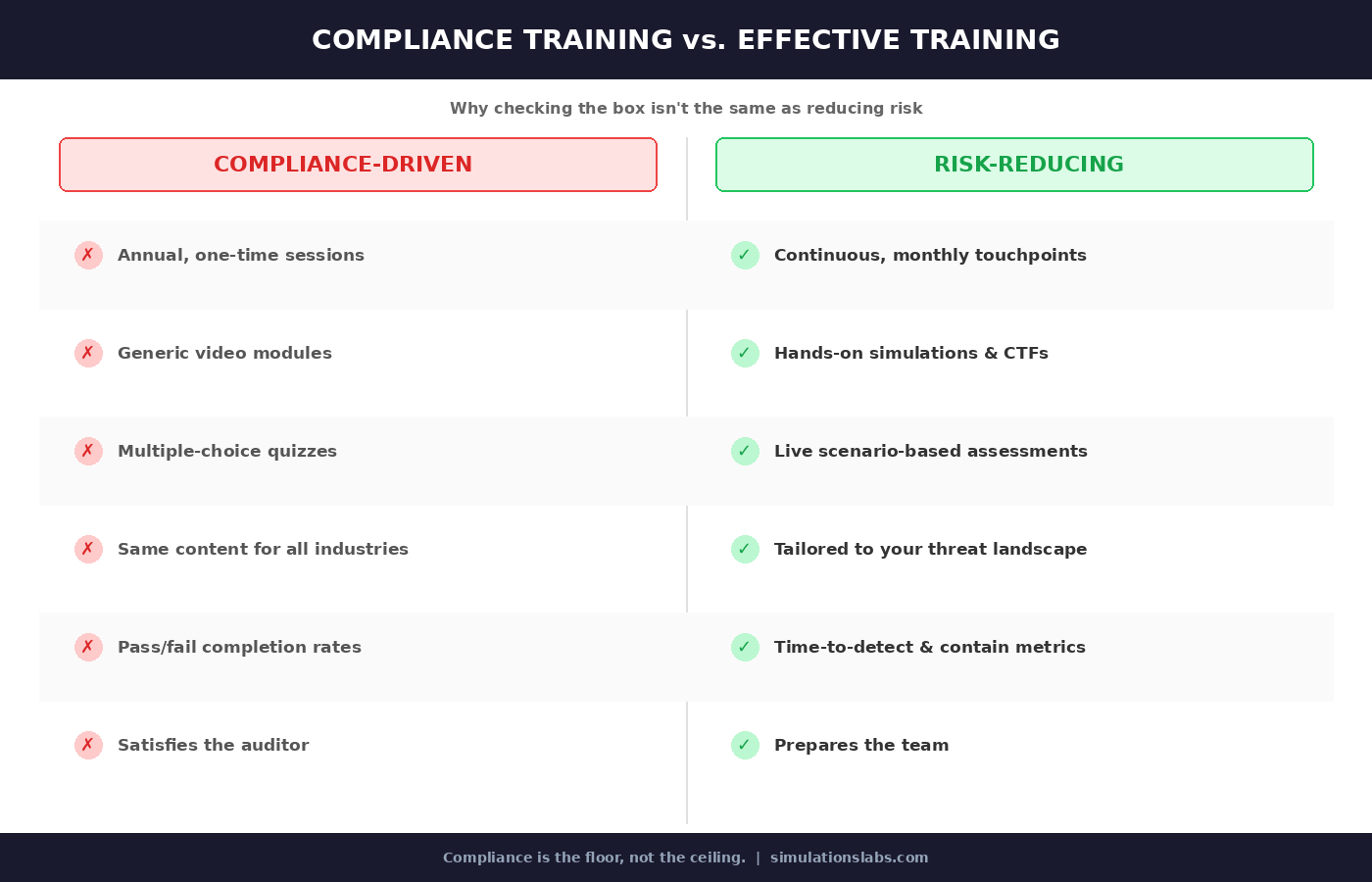
Programs that genuinely reduce risk share a few characteristics. They’re hands-on—people learn security skills by doing, not by watching. They’re continuous, with regular touchpoints rather than a single annual session. They’re relevant, reflecting your actual threat landscape. And they’re measured by meaningful metrics like time-to-detect and time-to-contain, not just completion rates.
The infographic below breaks down exactly where these two approaches diverge:
Building the Bridge Between Compliance and Competence
This doesn’t mean throwing out compliance entirely. Regulatory requirements exist for a reason, and meeting them is non-negotiable. The point is that compliance should be the floor, not the ceiling.
Start by mapping your compliance training requirements against actual risk priorities. Identify the gaps—the areas where a checked box doesn’t translate to real-world readiness. Then layer practical, scenario-based training on top of your compliance baseline.
Platforms like SimulationsLabs make this practical by letting organizations design and deploy custom cybersecurity simulations that map to both compliance needs and operational realities. You can run a CTF that satisfies your training documentation requirements while also giving your team hands-on experience with the exact attack vectors that matter to your environment.
The Bottom Line
Compliance-driven training will keep your auditors happy. But it won’t keep your organization safe. If your cybersecurity training program begins and ends with regulatory checkboxes, you’re investing resources in a false sense of security.
The organizations that actually reduce their risk are the ones that treat training as a continuous, practical, and measurable discipline—not a one-time compliance exercise. The gap between “compliant” and “prepared” is where breaches happen. Close that gap, and you’re not just meeting standards. You’re actually defending your organization.
FAQ
What is compliance-driven cybersecurity training?
Compliance-driven training is training primarily designed to meet regulatory requirements such as PCI DSS, HIPAA, SOC 2, or GDPR. Its main objective is often proving that employees completed required training rather than improving real-world security readiness.
Why doesn't compliance-driven training always improve security?
Many compliance-focused programs rely on generic content, annual training schedules, and simple quizzes. While these approaches may satisfy audit requirements, they often fail to prepare employees for real-world cyber threats and incidents.
What are the biggest weaknesses of traditional compliance training?
Common weaknesses include:
- Infrequent training sessions
- Generic content
- Limited hands-on practice
- Multiple-choice assessments
- Lack of relevance to current threats
- Focus on completion rates rather than performance
These limitations reduce the program's ability to change behavior or improve response capabilities.
Why is the "checkbox mentality" dangerous?
When training exists only to satisfy auditors, organizations may mistakenly believe they are prepared for cyber incidents. Compliance reports may look positive while employees have little practical experience responding to realistic threats.
Can an organization be compliant and still vulnerable?
Yes. The document notes that post-breach investigations often cite inadequate training and slow incident response as contributing factors, even when organizations were fully compliant with relevant regulations.
What does effective cybersecurity training look like?
Effective training programs are:
- Hands-on
- Continuous
- Relevant to actual threats
- Scenario-based
- Measured using operational outcomes
The focus is on developing practical skills and improving readiness rather than simply completing training requirements.
What metrics should organizations track instead of completion rates?
Organizations should focus on operational metrics such as:
- Time-to-detect (TTD)
- Time-to-contain (TTC)
- Incident response performance
- Behavioral improvements
- Simulation outcomes
These metrics provide a clearer picture of security readiness.
Should organizations abandon compliance training?
No. Compliance remains necessary and non-negotiable. The key message is that compliance should be the foundation of a training program, not the final goal.
How can organizations bridge the gap between compliance and competence?
Organizations should:
- Map compliance requirements to real business risks.
- Identify readiness gaps.
- Add practical, scenario-based training.
- Conduct simulations and exercises aligned with actual threats.
- Measure operational performance over time.
How can simulations support both compliance and readiness?
Simulation platforms can provide documented training activities that satisfy compliance requirements while also giving employees practical experience with realistic attack scenarios and incident response exercises.
What is the key takeaway from this article?
Compliance may keep auditors satisfied, but it does not automatically make an organization secure. The most effective organizations treat cybersecurity training as a continuous, practical, and measurable discipline focused on reducing risk and improving readiness.