A new approach to cybersecurity education is proving that the best way to develop skilled professionals is to place students in real-world scenarios — not just teach them about the threats.
Ask any cybersecurity hiring manager what they look for in a graduate, and the answer is nearly always the same: someone who has actually done the work. Not someone who understands the theory, but someone who has sat inside a compromised system, identified what went wrong, and decided under pressure.
Most university programs are not producing those graduates yet. The curriculum is often strong — the conceptual foundations are there, the frameworks are covered, and the assessments are rigorous. What is missing is the experience of applying all of it in a real-world situation.
Cybersecurity simulations fill that gap. And universities that integrate them into their programs are already seeing the difference.
The Problem With Theory-Only Education
Cybersecurity is unusual among technical disciplines in how quickly abstract knowledge becomes irrelevant without practice. A student who learned about network intrusion detection two semesters ago and has not touched a live environment since has lost most of the operational value of that knowledge. The field moves fast, and retention requires doing.
There is also a confidence problem. Graduates who have only studied security are often hesitant in their first professional role — not because they lack knowledge, but because they have never been tested under conditions that resemble real work. That hesitancy is costly for employers and frustrating for the graduates themselves.
Universities that take this seriously are not replacing their existing curriculum. They are adding a layer that activates it — structured simulation experiences that ask students to apply what they have learned in environments that behave like the real world.
What Cybersecurity Simulations Are?
A cybersecurity simulation places students inside a controlled, realistic environment and gives them a problem to solve. The problem might be exploiting a vulnerability in a test system, defending a network against a simulated attack, investigating a forensic trail, or cracking an encrypted message using the methods they have studied.
These scenarios are competitive. Students or teams work simultaneously, and the competitive format matters — it drives engagement in a way that a lab exercise or problem set rarely does. When students know that others are working toward the same goal at the same time, they focus differently. They go deeper. They are more likely to try an approach they would not have attempted otherwise.
The best simulations are also educationally deliberate. Each scenario maps to specific skills and knowledge areas. A module on web security is followed by a simulation involving web-based attack scenarios. A unit on cryptography ends with a scenario that requires students to apply cryptographic reasoning to break something. The simulation is not a bonus activity at the end of the term — it is an integral part of how learning is delivered and assessed.
How Simulations Labs Makes This Possible
The practical challenge for most universities has been infrastructure. Building and running well-designed cybersecurity simulations historically required significant technical resources — dedicated servers, custom challenge development, platform maintenance. For departments without a team devoted to it, that cost was prohibitive.
Simulations Labs removes that barrier entirely. It is a no-code platform that allows faculty to design, launch, and manage cybersecurity simulations without writing infrastructure code or involving IT. Scenarios are drawn from a comprehensive library that spans web security, network analysis, cryptography, reverse engineering, forensics, and more. Competitions can be configured and launched in under an hour.
The platform also handles everything that happens during and after a simulation: real-time scoring and leaderboards, individual and cohort-level analytics, challenge hints, and post-event performance reports. Faculty see exactly how students performed, which scenarios were solved quickly, which were abandoned, and what the distribution of skills looks like across the class.
That combination — ease of setup and depth of analytics — is what makes it practical to run simulations regularly, not just once a year as a special event.
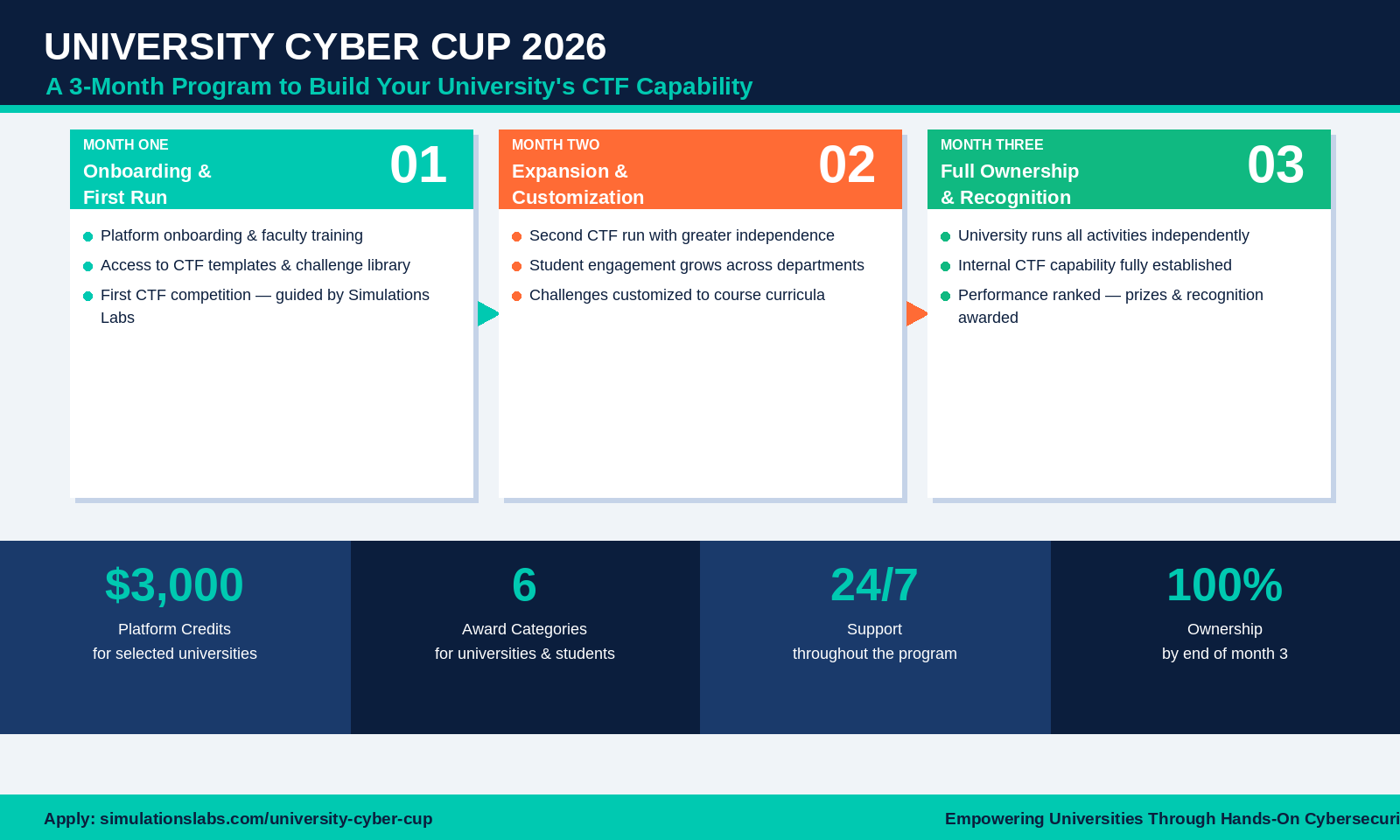
The University Cyber Cup gives institutions a structured three-month path to building independent simulation capability.
What Integration Looks Like in Practice
Universities that have successfully integrated simulation-based learning tend to approach it in stages rather than trying to transform the entire curriculum at once.
The first step is usually running a single simulation event — one well-designed scenario tied to the current course content — and treating it as a pilot. That event reveals what the platform can do, how students respond, and what logistical questions need answers. It is a low-risk way to build institutional knowledge and faculty confidence.
From there, the natural progression is to make simulations a recurring feature of specific courses. A network security course runs a simulation during week ten. A digital forensics module ends with a scenario that requires students to reconstruct a breach from evidence. The simulation becomes part of how those courses are structured, not an optional extra.
Over time, the goal is to build a culture of applied practice — where students expect to be tested in realistic conditions, where the most capable students are identified and challenged early, and where the program's reputation is built at least partly on the employability of its graduates.
The Effect on Students
Students who participate in regular cybersecurity simulations develop something that is difficult to teach through lectures alone: operational confidence. They have been inside a live scenario. They have made decisions under pressure. They know what it feels like when something does not work and they have to try a different approach.
That experience changes how they present themselves to employers. They can speak concretely about what they have done, not just what they know. In a field where demonstrated skill matters as much as credentials, that distinction is significant.
Students also build something tangible during their time in the program: a record of participation and performance across multiple scenarios. That record is visible, shareable, and meaningful to hiring managers who know what it takes to perform well in a competitive simulation environment.
A Starting Point
For universities ready to move in this direction, Simulations Labs offers both the platform and a structured entry point. The University Cyber Cup is a three-month program that takes institutions from their first simulation to running scenarios independently, with guidance throughout. It is designed specifically for universities that want to build this capability without having to invent everything from scratch.
But the program is just an on-ramp. The destination is a cybersecurity curriculum that treats simulation not as an enhancement but as a core component — the mechanism by which students prove, to themselves and to future employers, that they are ready to do the work.
That is the shift that matters. And the universities making it now are the ones that will be defining what good cybersecurity education looks like for the next decade.
About Simulations Labs
Simulations Labs is a no-code cybersecurity simulation platform used by universities, enterprises, and training programs worldwide to deliver hands-on cybersecurity scenarios and competitions. Learn more at simulationslabs.com.
FAQ
Why should cybersecurity simulations be part of university curricula?
Cybersecurity simulations help bridge the gap between theoretical knowledge and real-world application. They allow students to practice solving realistic security challenges, making them better prepared for professional cybersecurity roles after graduation.
What problem do simulations solve in cybersecurity education?
Many university programs provide strong theoretical foundations but limited opportunities for practical application. Simulations give students hands-on experience applying concepts in environments that resemble real-world cybersecurity operations.
Why is theory-only cybersecurity education not enough?
Cybersecurity skills are highly practical and require regular application. Knowledge that is not reinforced through hands-on experience can lose much of its operational value over time.
How do simulations help students build confidence?
Students who participate in realistic scenarios gain experience making decisions under pressure, troubleshooting problems, and adapting when initial approaches fail. This builds operational confidence that lectures alone cannot provide.
What is a cybersecurity simulation?
A cybersecurity simulation places students in a controlled environment where they must solve realistic security problems, such as:
- Exploiting vulnerabilities
- Defending networks
- Conducting forensic investigations
- Solving cryptographic challenges
These scenarios replicate real-world cybersecurity tasks.
Why are competitive simulations effective for learning?
Competition increases engagement and motivation. When students work against peers to solve challenges, they often explore deeper solutions, take more initiative, and remain focused for longer periods.
How do simulations improve knowledge retention?
Research on active learning shows that students retain information more effectively when they apply it in realistic, high-engagement environments. Cybersecurity skills are especially dependent on practical application rather than passive learning.
How can simulations help faculty members?
Simulations provide valuable insight into student performance. They help instructors identify:
- Knowledge gaps
- Difficult concepts
- High-performing students
- Areas where curriculum improvements are needed
The resulting data becomes a useful feedback mechanism for course design.
What challenges prevent universities from adopting simulations?
Historically, cybersecurity simulations required significant infrastructure, including servers, challenge development, and platform maintenance. These technical requirements made implementation difficult for many institutions.
How does Simulations Labs help universities implement simulations?
Simulations Labs provides a no-code platform that enables faculty to create, launch, and manage cybersecurity simulations without building complex infrastructure. The platform includes challenge libraries, scoring systems, analytics, and reporting capabilities.
How can universities integrate simulations into existing courses?
Many institutions start with a pilot simulation tied to a specific course. Once successful, simulations can become recurring activities within courses such as:
- Network Security
- Digital Forensics
- Web Security
- Cryptography
- Incident Response
This gradual approach allows programs to build capability over time.
What benefits do students gain from regular simulations?
Students develop:
- Operational confidence
- Practical cybersecurity skills
- Problem-solving abilities
- Experience working under pressure
- A portfolio of simulation performance
These experiences help them stand out during internships and job interviews.
What is the University Cyber Cup?
The University Cyber Cup is a structured three-month program designed to help universities build independent cybersecurity simulation capabilities and integrate hands-on learning into their curricula.
What is the key takeaway for universities?
The future of cybersecurity education requires more than lectures and exams. Universities that integrate simulations as a core part of learning can produce graduates who are better prepared, more confident, and more attractive to employers because they have already practiced real-world cybersecurity work.