Most developers don't write insecure code because they're careless. They write it because nobody ever showed them what an exploit looks like from the attacker's side.
A slide deck on SQL injection rarely changes behavior. Breaking a vulnerable login form yourself, then patching it, almost always does. That shift, from reading about vulnerabilities to experiencing them, is the core of a developer's secure coding journey.
In this post, we'll map that journey stage by stage, show where traditional training falls short, and explain how Simulations Labs uses AI for CTF-style learning to help startups, SMEs, and enterprises build security skills that actually stick.
Why Developers Ship Vulnerable Code in the First Place
Before fixing the problem, it helps to understand its roots. Across teams of every size, the same patterns show up:
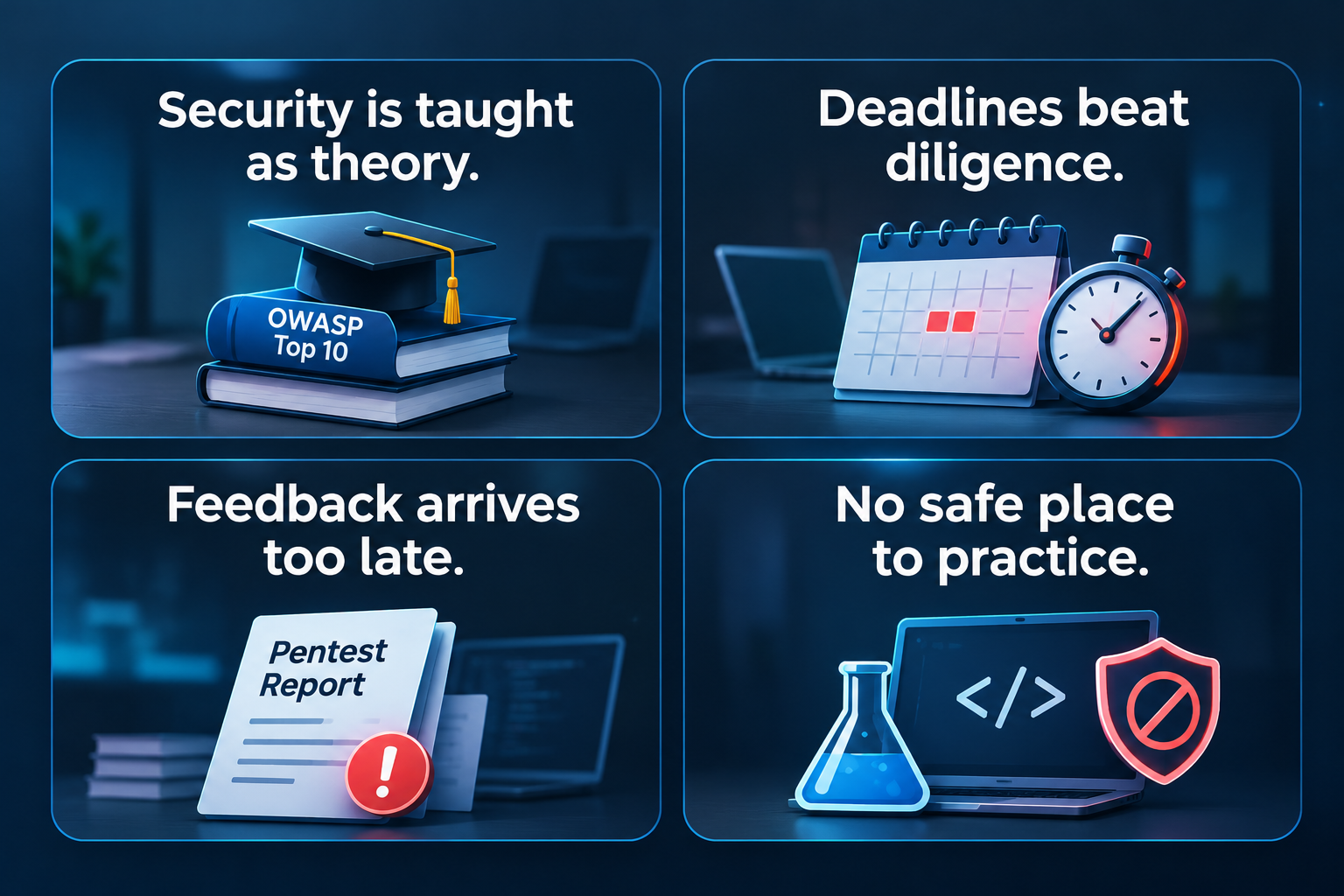
- Security is taught as theory. Developers memorize the OWASP Top 10 but never see a real payload succeed.
- Deadlines beat diligence. Under sprint pressure, "it works" wins over "it's safe."
- Feedback arrives too late. A pentest report six months after release teaches very little.
- No safe place to practice. You can't test an exploit against production, and setting up a lab takes days.
Key insight: Vulnerable code is a training problem before it's a tooling problem. Scanners catch symptoms; skilled developers prevent causes.
The Developer's Secure Coding Journey: 4 Stages
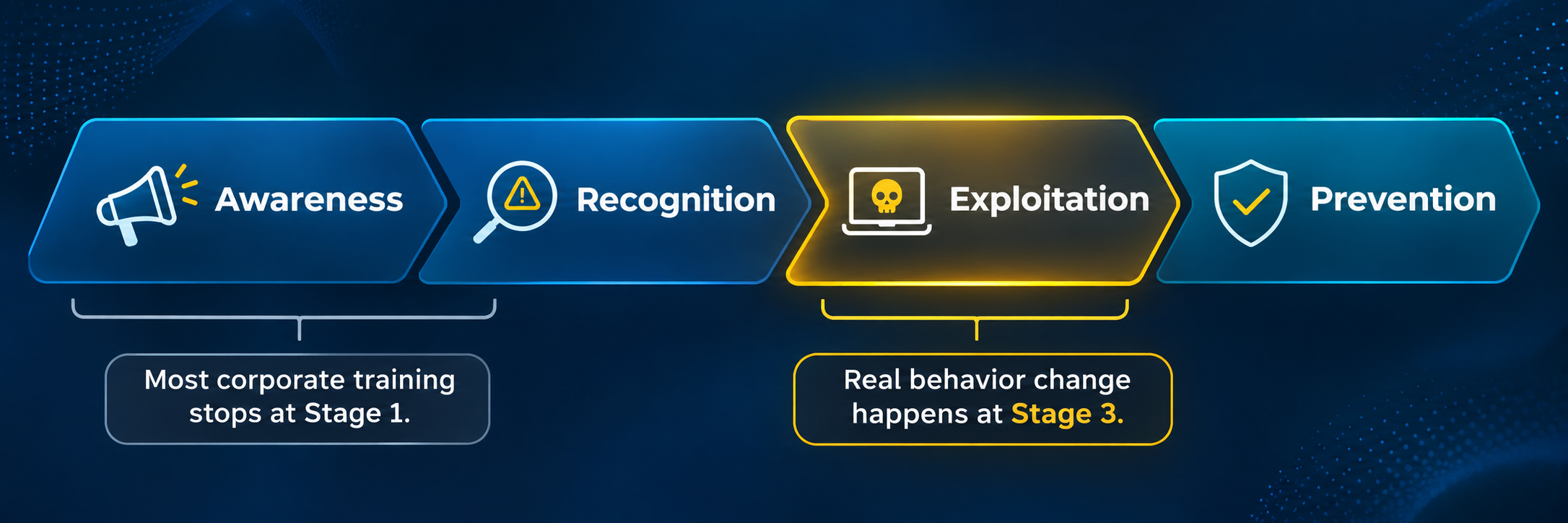
Secure coding skills develop in a predictable sequence. Knowing which stage your team is at tells you what kind of training they need next.
Stage 1: Awareness – "I know vulnerabilities exist"
The developer has heard of XSS, injection, and broken authentication. They can define them but can't reliably spot them in a code review.
What works here: Short, hands-on demos where the developer sees an exploit succeed against realistic code.
Stage 2: Recognition – "I can see the flaw"
The developer begins noticing unsanitized inputs, hardcoded secrets, and missing authorization checks in pull requests.
What works here: Code-review challenges and "find the bug" labs with immediate feedback.
Stage 3: Exploitation – "I understand how it's abused"
This is the turning point. The developer plays attacker in a sandboxed environment, chaining a weak session token into account takeover, for example. Once you've done that, you never look at session handling the same way.
What works here: Capture the Flag (CTF) challenges in isolated Docker containers.
Stage 4: Prevention – "I design it securely from the start"
Secure patterns become default habits: parameterized queries, least privilege, input validation at boundaries, dependency hygiene.
What works here: Recurring practice, team competitions, and measurable progress tracking.
Why Hands-On CTF Labs Beat Traditional Security Training
Capture the Flag exercises were once a hacker-community pastime. Today they're one of the most effective secure coding training formats for engineering teams, and for good reason.
| Traditional Training | CTF-Based Learning |
|---|---|
| Passive videos and slides | Active problem-solving |
| Generic examples | Realistic, exploitable applications |
| Completion certificates | Measurable skill data per challenge |
| Forgotten in weeks | Retained through experience |
| One-size-fits-all | Scalable difficulty per role |
A real-world example: A fintech SME runs a monthly internal CTF on the Simulations Labs competition module. Developers exploit a vulnerable clone of their own payment API, then submit fixes. Within three cycles, injection-related findings in their pentest reports dropped noticeably, not because of a new scanner, but because the team had personally broken the same patterns.
AI for CTF: Removing the Biggest Barrier to Developer Security Training
Here's the honest reason most companies don't run CTFs: building them is hard. You need someone to write challenges, containerize them, host them securely, and manage scoring. For a startup or SME without a dedicated security team, that's a non-starter.
This is where AI for CTF changes the equation. The Simulations AI Copilot inside Simulations Labs gives organizers access to a large library of ready-made challenges across web security, cryptography, forensics, network security, and more, so a team lead with no offensive security background can launch a realistic simulation in minutes.
What that looks like in practice:
- Create: Pick challenges from the AI-powered library or upload your own Docker containers.
- Launch: Share a link with your developers. Labs spin up on demand in isolated environments.
- Monitor: Watch the live leaderboard, see first solvers, and spot which challenges generate the most wrong attempts (your team's real skill gaps).
Key insight: Analytics like "most frequent wrong attempts per challenge" are more useful than any quiz score. They tell you precisely where your developers' mental models break down..
Secure Code Is Learned by Doing
The journey from vulnerable code to secure code isn't about memorizing more rules. It's about giving developers a safe, realistic place to break things, understand why they broke, and build the instinct to prevent it next time.
With AI for CTF challenge creation, fully managed Docker labs, and analytics that reveal real skill gaps, Simulations Labs makes that kind of training practical for startups, SMEs, and enterprises alike, without a security team or infrastructure budget.
Ready to see it in action?see the product demo and launch your first developer security simulation in minutes.
Frequently Asked Questions
How do developers actually learn secure coding?
Most effectively through hands-on practice: exploiting realistic vulnerable applications in a sandbox, then fixing them. Reading about vulnerabilities builds awareness; exploiting them builds lasting judgment.
What is AI for CTF, and why does it matter?
AI for CTF refers to using AI-powered engines to generate or curate Capture the Flag challenges automatically. It removes the biggest barrier to running CTFs, challenge creation, so non-security teams can launch realistic training quickly.
What are the best CTFd alternatives for companies?
Look for platforms with managed hosting, built-in challenge libraries, Docker-based isolated labs, dynamic flags, and performance analytics. Simulations Labs covers all of these with SaaS, private, and local hosting options.
Can a startup without a security team run CTF-based training?
Yes. With a ready-made challenge library and fully managed infrastructure, a team lead can set up and launch a developer CTF without DevOps or offensive security expertise.
How often should developers do security training?
Short, recurring sessions beat annual marathons. A quarterly CTF plus occasional targeted labs keeps secure coding habits active without disrupting delivery.
Is CTF training only for security professionals?
No. CTF challenges scale from beginner to expert, making them effective for developers, QA engineers, and even non-technical staff in security awareness programs.