Three out of four organizations now have an AI usage policy. Roughly a third have an actual governance framework behind it, and fewer than half monitor the AI systems already running in their environment. Deloitte's 2026 research adds a sharper edge to the gap: 74% of organizations plan to deploy agentic AI within two years, but only about one in five have a mature model for governing the autonomous agents they intend to run. Read together, these aren't the numbers of an industry short on policies. They're the numbers of an industry that has confused having a policy with being prepared.
Preparing a cybersecurity team for AI isn't a training question alone; it's a readiness question that spans governance, visibility, and incident response, most of which has nothing to do with a course curriculum.
-
Start With Governance, Not Tooling
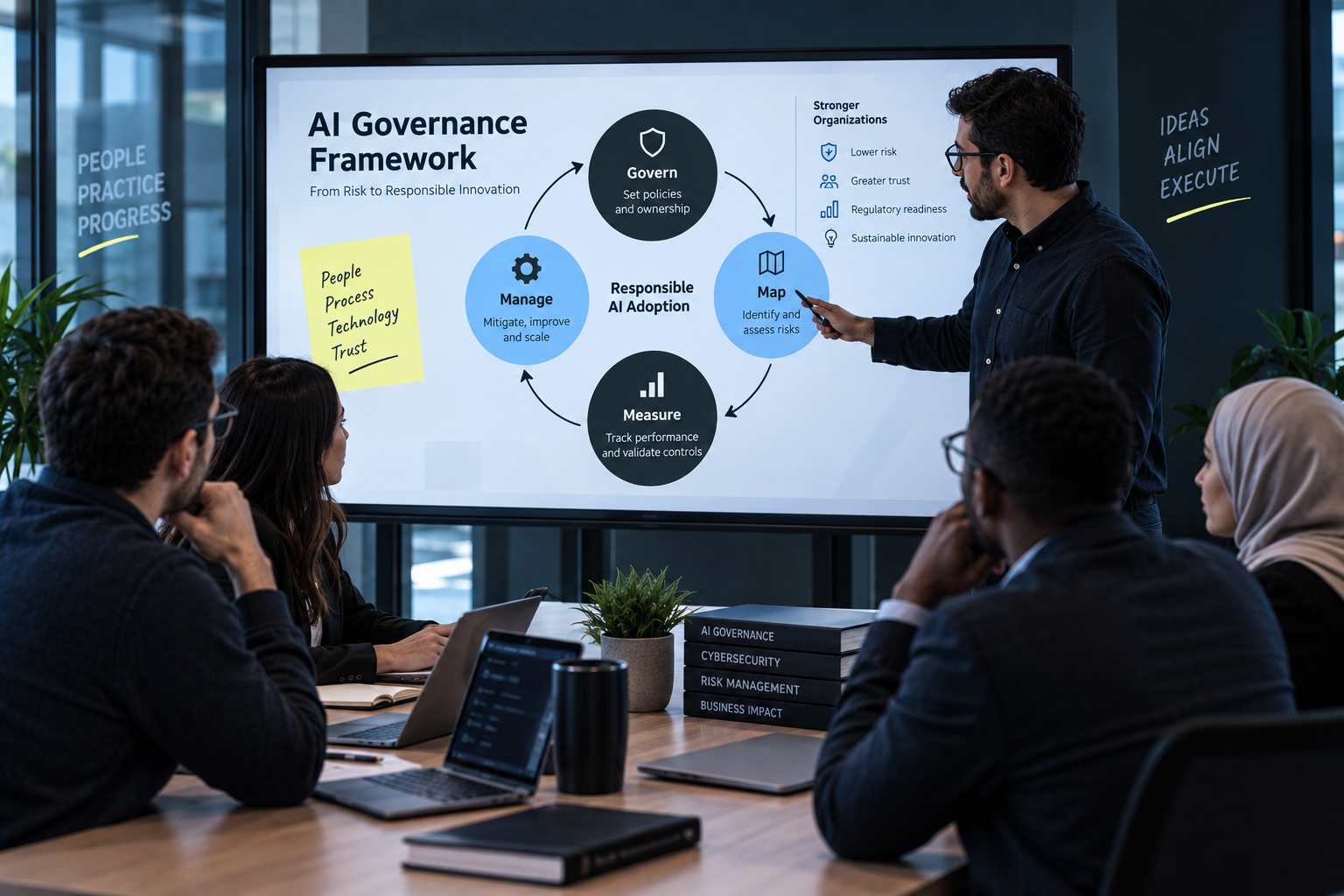
The instinct in most organizations is to solve "AI readiness" by buying AI-powered security tools. That's not where the actual gap sits. The NIST AI Risk Management Framework, the most widely referenced structure for this exact problem, organizes AI risk work around four functions: Govern, Map, Measure, and Manage, applied iteratively rather than as a one-time checklist.
For a cybersecurity team specifically, this translates into concrete questions most organizations haven't formally answered: Who owns decisions about which AI tools are approved for use in security workflows? Who's accountable when an AI-assisted triage tool gets something wrong? What's the process for evaluating a new AI capability before it touches production systems? Without governance answers to these questions, training and tooling investments sit on an unstable foundation; teams end up reactively figuring out ownership during an incident, which is the worst possible time to be doing it for the first time.
-
Close the Shadow AI Blind Spot
A cybersecurity team can't prepare for risks it can't see, and shadow AI employees using unsanctioned AI tools, including on the security team itself, is a documented, measurable blind spot. IBM's 2025 breach research found that breaches involving shadow AI had longer lifecycles than the global average (247 days versus 241) and higher rates of both customer data compromise (65% versus 53%) and intellectual property theft. Ninety-seven percent of AI-related breaches in the same research lacked proper access controls entirely.
This matters directly for a security team's own readiness, not just the rest of the company's. Security analysts using an unsanctioned AI assistant to help draft an incident report, summarize logs, or explain a piece of malware are potentially feeding sensitive data into a system nobody has vetted, a risk that's easy to overlook precisely because the intent is entirely legitimate. Preparing a team for AI means auditing what AI tools are already in use inside the security function itself, not just what's approved company-wide on paper.
-
Update Incident Response Plans for AI-Specific Scenarios
Most incident response plans were written before AI-driven attacks were a meaningful category, and it shows. A plan built around traditional phishing, malware, and credential-theft playbooks doesn't necessarily have a clear path for a deepfake-based impersonation attempt on a finance team, or an AI-generated phishing campaign personalized well enough that standard red flags no longer apply, or misuse of an internal AI agent with more system access than anyone realized it had.
Preparing a team means walking through these scenarios deliberately before they happen, not improvising a response the first time one does. That includes specific escalation paths for AI-related incidents, clear ownership of the decision to take an AI system offline if it's implicated in an incident, and communication templates that account for how convincing AI-generated social engineering has become, since "we'll know it when we see it" is no longer a reliable detection strategy for a team's own employees.
-
Build Cross-Functional Readiness, Not Just Security-Team Readiness
The NIST framework's "Map" function is explicit that AI risk requires context that rarely sits inside a security team alone; legal, data governance, and IT all hold pieces of the picture a security team needs to actually assess AI risk accurately. A security team preparing in isolation, without a working relationship with whoever manages data classification or AI vendor approval, will keep discovering gaps reactively instead of proactively. Preparing the team means building those cross-functional links before an incident forces the introduction.
-
Invest in Verified Skill, Not Just Policy Documents
Governance and incident response plans answer "what should happen." They don't answer whether the team can actually execute under pressure; that's a separate, practiced skill, and it's the piece most preparation efforts skip because it's harder to document than a policy. A team that has a written plan for a deepfake-based incident but has never rehearsed one under time pressure is meaningfully less prepared than the document suggests.
-
Making Readiness Concrete, Not Aspirational
Governance frameworks and incident response plans matter, but they only prove their worth under real conditions, which means readiness has to include actual practice, not just documentation. Simulations Labs' Cyber Range is built for exactly this: live-fire, production-safe exercises that let teams rehearse incident response against realistic, evolving scenarios, including the kinds of AI-driven attack patterns most legacy incident response plans were never written to handle. For organizations building this out as an ongoing capability rather than a one-time drill, security team upskilling programs give teams a structured way to keep pace as both governance requirements and attacker tooling continue to shift.
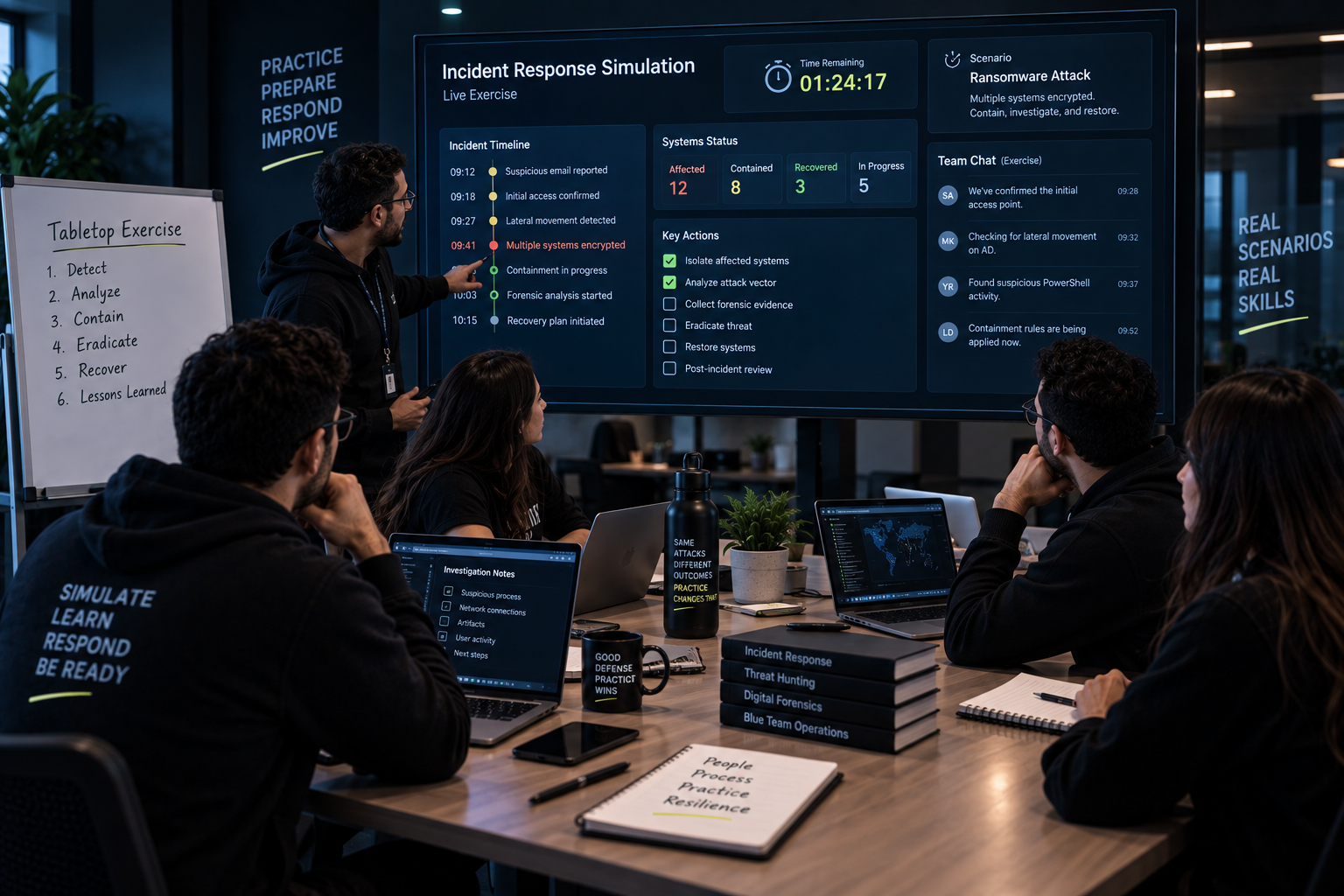
Ready to see whether your team's incident response actually holds up under an AI-relevant scenario? Explore the Simulations Labs Cyber Range and test your readiness against a real, timed simulation instead of a written plan alone.
-
FAQ
What's the difference between an AI policy and an AI governance program? A policy states rules: which tools are approved, and what data can be shared with them. A governance program assigns ongoing ownership, monitoring, and accountability for those rules being followed and updated. Research shows roughly three-quarters of organizations have the former, while only about a third have the latter, which is why so many AI policies exist but aren't consistently enforced.
What is shadow AI, and why does it matter for a security team specifically? Shadow AI refers to employees using AI tools that haven't been vetted or approved by the organization. For a security team, this is a particular risk because analysts may use unsanctioned tools to help with genuinely legitimate tasks, such as summarizing an incident or explaining malware behavior, while inadvertently exposing sensitive data to an unvetted system. IBM's research found shadow AI breaches take longer to resolve and involve higher rates of data compromise than average.
Does an incident response plan need a separate section for AI-related incidents? It's worth having explicit, rehearsed playbooks for AI-specific scenarios, deepfake impersonation, AI-generated phishing, misuse of an internal AI agent, rather than assuming existing playbooks cover them by extension. These scenarios often have different detection signals and escalation needs than the traditional incidents most IR plans were originally built around.
Why does AI readiness need cross-functional involvement beyond the security team? Because a security team rarely has full visibility into which AI tools are in use, what data those tools touch, or how they were vendor-approved, without input from IT, legal, and data governance functions. NIST's AI Risk Management Framework explicitly treats this kind of cross-functional context-mapping as a foundational step, not an optional add-on.
Is training enough to prepare a cybersecurity team for AI? No, training builds individual skill, but organizational readiness also requires governance structure, incident response planning, and cross-functional coordination that a training curriculum alone doesn't address. The strongest preparation combines governance and planning with verified, practiced skill through hands-on exercises.