When people talk about the cost of a data breach, they usually focus on the obvious numbers: regulatory fines, legal fees, customer notification expenses, and remediation costs. These figures get the headlines and make their way into board presentations. But there’s a cost that rarely shows up in those reports, and it’s often the largest one: the price of slow, uncertain, or ineffective incident response caused by undertrained teams.
The difference between a well-trained response team and one that’s improvising in real time isn’t marginal. It can be the difference between containing a breach in hours versus weeks—and the financial impact scales accordingly.
Where the Real Cost Lives
Incident response isn’t just about having the right tools. SIEM platforms, EDR solutions, and SOAR playbooks are useless if the people operating them don’t know how to interpret alerts, investigate effectively, and take decisive containment actions under pressure.
The hidden costs compound in several ways. Dwell time increases because analysts can’t distinguish real threats from noise quickly enough. Containment is delayed because responders hesitate or follow outdated procedures. Escalation chains break down because team members aren’t practiced in communication protocols during a live event. And post-incident recovery takes longer because documentation and forensic preservation are handled poorly from the start.
Every additional hour a breach goes uncontained adds to the bill. More records get exfiltrated. More systems get compromised. More business operations get disrupted.
The Impact by Industry
The cost of untrained responders varies by sector, but the pattern is consistent. Industries with sensitive data, complex regulations, and interconnected systems pay the steepest price when their teams aren’t prepared. Here’s how it breaks down:
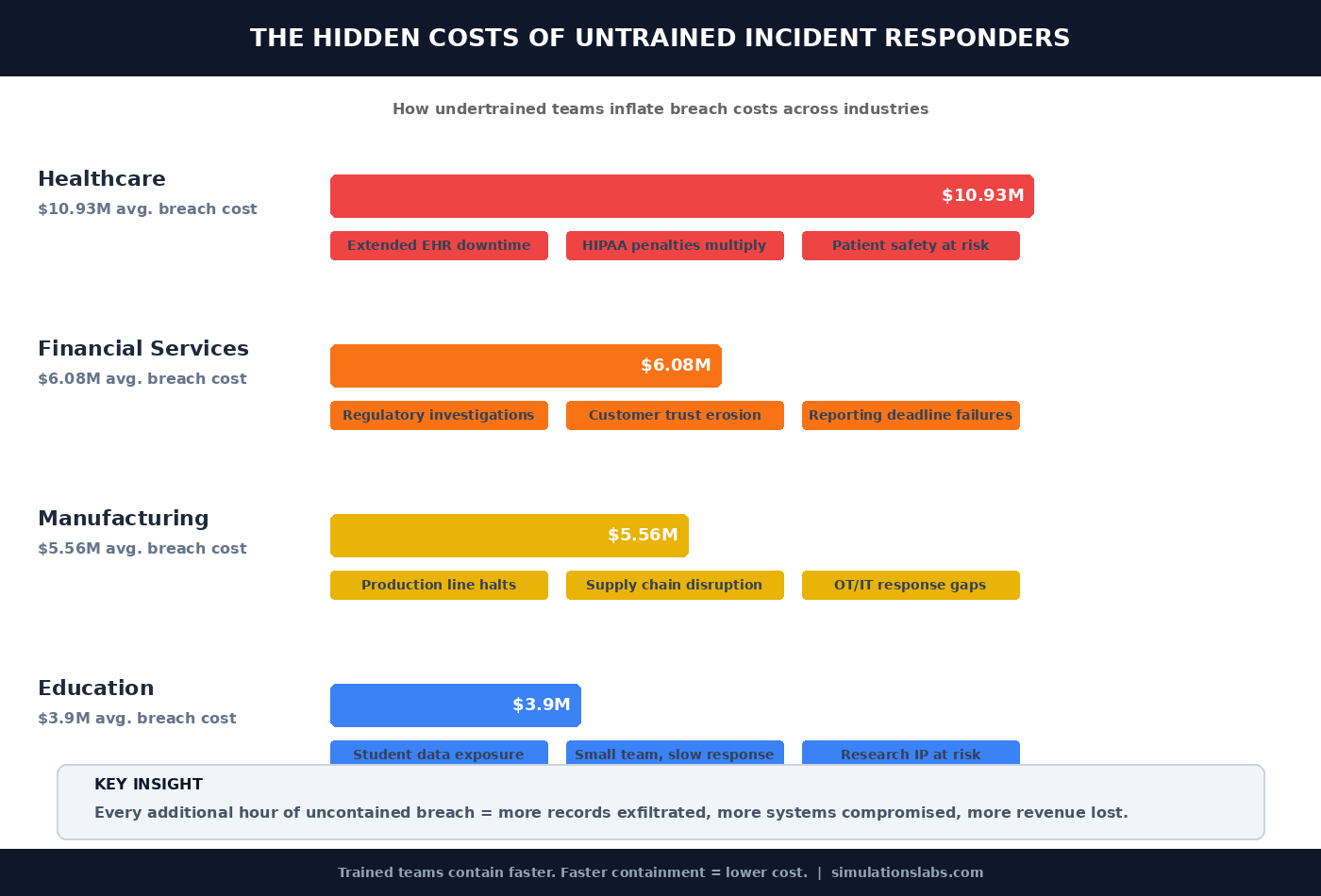
Healthcare leads the pack for a reason. The combination of sensitive patient data, HIPAA obligations, and interconnected medical systems creates an environment where slow response is catastrophic. When responders aren’t trained on healthcare-specific scenarios—like ransomware targeting EHR systems—containment drags out, and regulatory penalties stack up.
Financial services face dual pressure: direct losses and the regulatory scrutiny that follows. A team that mishandles evidence or misses reporting deadlines under DORA or PCI DSS can turn a containable incident into a prolonged investigation. And in this sector, customer trust, once broken, rarely comes back.
Manufacturing and critical infrastructure deal with the convergence of IT and OT environments, where a cyberattack can halt production lines or create safety hazards. Without specialized OT training, response teams lose critical hours trying to figure out unfamiliar systems while operational downtime costs mount.
Educational institutions hold vast amounts of personal data but operate with smaller teams and tighter budgets. The result is often general IT staff handling incidents they’re not equipped for, leading to extended exposure windows.
The Multiplier Effect of Preparation
Organizations with tested incident response plans and trained teams consistently experience lower breach costs. The keyword is “tested.” Having a plan in a binder isn’t the same as having a team that has practiced executing it under realistic conditions.
Regular simulation-based training—cyber range drills, CTF-style challenges, tabletop exercises—creates muscle memory. When a real incident hits, trained responders execute instead of freezing. That speed translates directly to cost savings: fewer compromised records, less operational disruption, and cleaner regulatory reporting.
Making the Case Internally
If you’re justifying investment in response training to leadership, shift the conversation from “training cost” to “breach cost avoidance.” Every dollar spent on practical, hands-on training reduces the expected cost of your next incident by a measurable amount.
Platforms like SimulationsLabs let you run realistic incident response drills without building custom lab environments from scratch. Simulate industry-specific scenarios, measure response times, identify skill gaps, and track improvement—giving you concrete data for budget conversations.
The Bottom Line
The cost of untrained incident responders doesn’t show up as a line item. It shows up as longer dwell times, larger blast radii, steeper fines, and more serious reputational damage. Across every industry, the pattern holds: organizations that invest in regular, realistic training recover faster and spend less when incidents happen.
The question isn’t whether your team will face a serious security incident. It’s whether they’ll be ready when it arrives. And that readiness doesn’t come from slide decks or annual quizzes. It comes from practice.
FAQ
What is the hidden cost of untrained incident responders?
The highest cost is not the training budget itself—it is the increased financial and operational impact of breaches caused by slow, uncertain, or ineffective incident response. Poorly trained teams often take longer to detect, investigate, and contain incidents, which increases overall damage.
Why is incident response training so important?
Security tools such as SIEM, EDR, and SOAR platforms are only effective when responders know how to interpret alerts, investigate incidents, and take decisive action under pressure. Training enables teams to use these tools effectively during real incidents.
How do undertrained responders increase breach costs?
Undertrained teams often experience:
- Longer attacker dwell times
- Delayed containment
- Poor communication during incidents
- Ineffective escalation processes
- Slower recovery efforts
- Incomplete forensic preservation
Each of these factors increases the overall impact and cost of a breach.
Why does every additional hour of an active breach matter?
Every hour a breach remains uncontained can lead to:
- More data is being exfiltrated
- More systems are being compromised
- Greater operational disruption
- Increased recovery costs
Speed is one of the most important factors in reducing breach impact.
Which industries are most affected by untrained incident responders?
According to the article, industries with sensitive data, strict regulations, and interconnected systems face the greatest risks. These include:
- Healthcare
- Financial Services
- Manufacturing
- Education
Why is healthcare especially vulnerable?
Healthcare organizations must protect sensitive patient information while complying with regulations such as HIPAA. Slow response to incidents like ransomware attacks targeting electronic health record (EHR) systems can lead to significant operational and regulatory consequences.
What challenges do financial services organizations face?
Financial institutions face both direct financial losses and intense regulatory scrutiny. Mishandling evidence or missing reporting deadlines under frameworks such as DORA or PCI DSS can significantly increase the cost and complexity of an incident.
Why is incident response training critical for manufacturing and critical infrastructure?
Manufacturing environments often combine IT and operational technology (OT) systems. Without specialized OT incident response training, teams may struggle to understand affected systems, leading to longer downtime, production disruptions, and safety risks.
What unique challenges do educational institutions face?
Educational organizations often manage large volumes of personal data while operating with smaller security teams and tighter budgets. As a result, incidents may be handled by general IT staff who lack specialized response training.
How does simulation-based training reduce breach costs?
Simulation-based exercises such as cyber range drills, tabletop exercises, and CTF-style challenges help teams build practical experience and muscle memory. Trained responders can act more quickly and confidently during real incidents, reducing damage and recovery costs.
Why should organizations focus on breach cost avoidance rather than training costs?
Training should be viewed as an investment that reduces the expected cost of future incidents. The cost of practical training is often far lower than the financial impact of delayed response, regulatory penalties, operational downtime, and reputational damage.
How can organizations measure the effectiveness of incident response training?
Organizations can measure:
- Response times
- Containment times
- Detection speed
- Skill gaps
- Improvement over time through simulations and exercises
These metrics provide tangible evidence of readiness improvements