Cybersecurity training is in the middle of a fundamental shift. For years, organizations relied on static courseware, scheduled compliance modules, and the occasional tabletop exercise to keep their teams sharp. That approach worked well enough when threat actors moved slowly, and attack surfaces were predictable. But the landscape has changed, and the old playbook no longer holds up.
Artificial intelligence is transforming both sides of the cybersecurity equation. Attackers are using AI to craft more convincing phishing campaigns, automate reconnaissance, and exploit vulnerabilities faster than ever. Defenders need to keep pace, and that means the way we train defenders has to evolve just as quickly.
This article explores how AI is reshaping cybersecurity training, what that means for security teams and hiring managers, and how platforms like Simulations Labs are leading this transition.
The Problem with Traditional Cybersecurity Training
Before we talk about where training is going, it helps to understand where it has been. Traditional cybersecurity training typically falls into a few familiar categories: annual compliance courses with multiple-choice quizzes, vendor-specific certification boot camps, one-off tabletop exercises, and static lab environments that rarely change.
Even many modern-looking cybersecurity platforms and CTF frameworks fall into the same trap. Platforms like CTFd and similar solutions, while valuable for hosting challenges, still rely heavily on static content, manual updates, and predefined scenarios. They often lack adaptive learning capabilities and have yet to fully integrate AI-driven guidance, personalization, or real-time feedback. As a result, they replicate the same limitations as traditional training—just in a more gamified format.
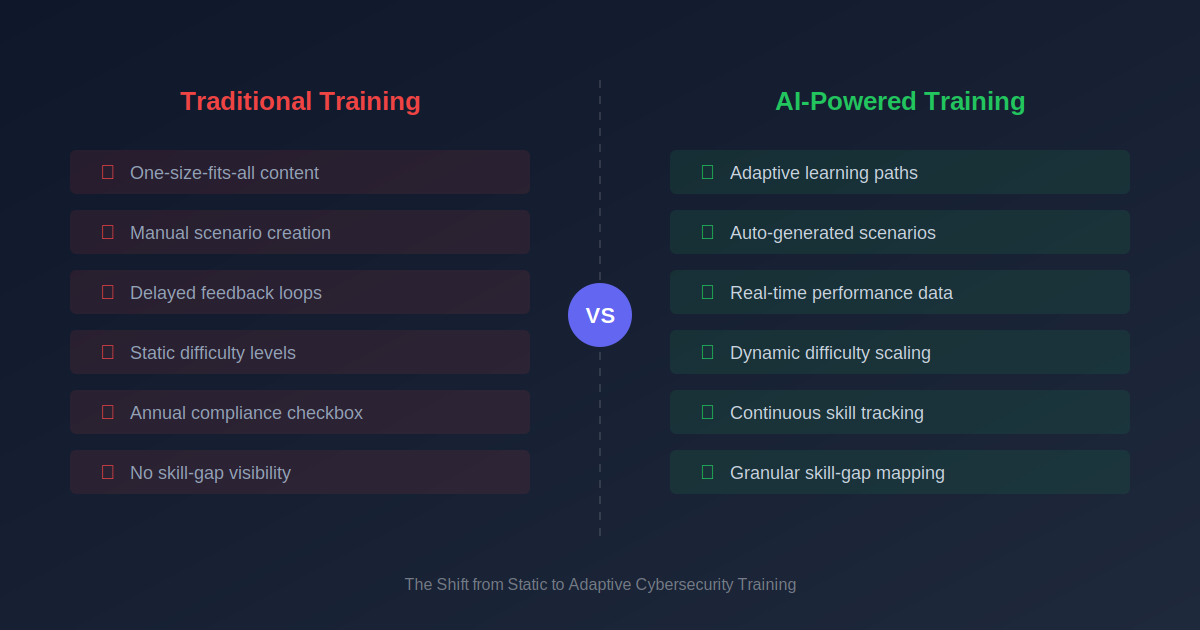
These methods share a common weakness: they are built around content, not around the learner. Everyone gets the same material regardless of their role, skill level, or the specific threats their organization faces. A junior analyst studying for their first SOC role receives the same training module as a senior engineer with a decade of experience.
The result is predictable: beginners feel overwhelmed, veterans feel bored, and neither group builds the practical muscle memory they need.
There is also a pacing problem. Threats evolve continuously, but most training content is updated at best quarterly. By the time a new module covers a novel attack technique, adversaries have already moved on to the next one. Organizations end up training their teams to fight last quarter’s war.
How AI Changes the Training Equation
AI-powered training platforms address these shortcomings by making training adaptive, continuous, and personalized. Instead of delivering the same content to every learner, AI analyzes each individual’s performance and adjusts the experience in real time. Here is how that plays out in practice.
Adaptive Learning Paths
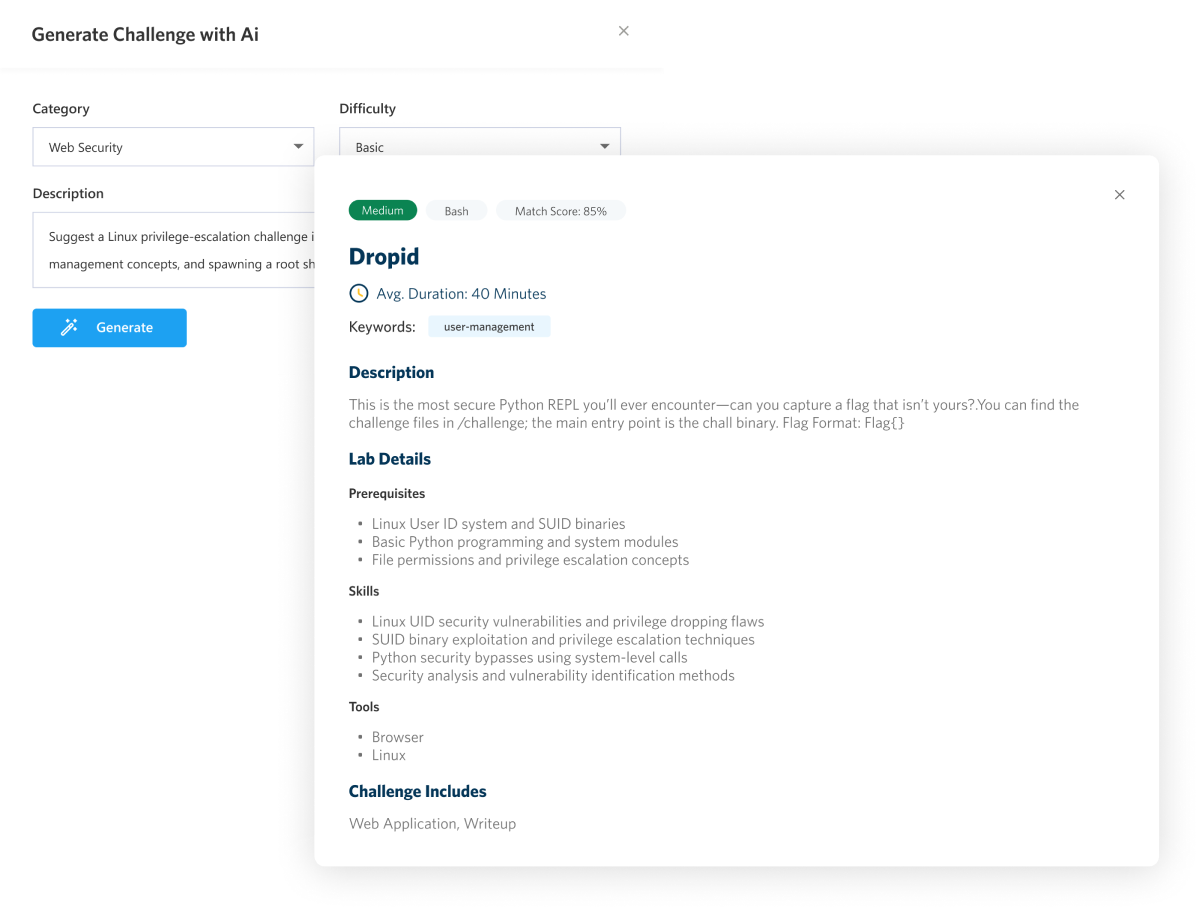
AI can assess what a learner already knows and what they need to work on. If someone consistently solves web application challenges but struggles with cryptography, the platform can automatically surface more cryptography exercises at the right difficulty level. This eliminates wasted time on material the learner has already mastered and focuses effort where it matters most.
Simulations Labs uses its Simulations AI Copilot to do exactly this. With a library of over 2,100 challenges spanning dozens of cybersecurity domains. It turns what would otherwise be a sprawling catalog into a guided experience.
Dynamic Scenario Generation
One of the biggest operational headaches in cybersecurity training is content creation. Building realistic, up-to-date scenarios takes time and specialized expertise. AI helps by generating new challenges and variations automatically, ensuring that learners never see the exact same scenario twice and that training stays aligned with current threat intelligence.
This is particularly valuable for organizations running regular CTF competitions or assessments. Instead of spending weeks building new challenge sets for each event, teams can use AI-assisted generation to produce fresh content rapidly while maintaining quality and relevance.
Real-Time Performance Analytics
Traditional training gives you a pass or fail. AI-powered platforms give you a detailed map of each learner’s strengths and weaknesses across multiple skill dimensions. Managers can see, at a glance, which team members need development in specific areas and track progress over time rather than relying on a single point-in-time assessment.
This data-driven approach also helps organizations make better hiring decisions. When you can see objective performance data from hands-on challenges, you move beyond resume keywords and interview impressions into evidence-based talent evaluation.
What This Means for Your Team
The shift to AI-powered training is not just a technology upgrade. It changes how security teams operate and how organizations think about workforce development.
For Security Managers
AI-powered training gives you visibility you have never had before. Instead of hoping your annual training program is effective, you can measure exactly which skills your team has and which ones are missing. You can identify your strongest incident responders, see who needs more practice with malware analysis, and build targeted development plans that actually close gaps rather than checking a compliance box.
This visibility also makes it easier to justify training budgets. When you can show leadership concrete data on skill improvements and gap closures, the conversation shifts from “do we really need this?” to “how do we expand it?”
For Hiring Teams
The cybersecurity skills gap remains one of the industry’s biggest challenges. Hundreds of thousands of positions go unfilled because organizations cannot find candidates with the right practical skills. AI-powered training platforms offer a better way to assess candidates: put them in realistic scenarios and measure what they can actually do, not what they say they can do on a resume.
Simulations Labs supports this use case directly. Organizations can create custom assessments, invite candidates to complete them, and review detailed performance reports that show exactly how each person performed across different challenge categories. It removes guesswork from the hiring process and reduces the risk of bad hires.
For Individual Practitioners
If you are building a career in cybersecurity, AI-powered training platforms let you learn more efficiently. Instead of working through a generic curriculum, you get a personalized path that challenges you at the right level and exposes you to the breadth of skills employers are looking for. The data you generate along the way, challenge completions, difficulty progressions, domain coverage, becomes a portfolio that demonstrates your capabilities far more effectively than a list of certifications.
The AI Advantage in SOC Operations
AI is not only changing how teams train; it is also changing how they operate. Security operations centers are increasingly adopting AI-driven tools for alert triage, threat hunting, and incident response. This creates a feedback loop: as SOC tools become more AI-driven, the teams using those tools need training that reflects how AI augments their workflows.
Training platforms that incorporate AI can simulate these workflows, helping analysts practice working alongside AI tools in a safe environment before encountering high-pressure situations in production. This is a critical gap that traditional training simply cannot fill.
Organizations that invest in AI-powered training now will find themselves better prepared to adopt AI-driven security tools in their operations. The skills transfer is direct: teams that are comfortable working with AI in training will be more effective working with AI in production.
Getting Started: Practical Steps
If your organization is still relying on traditional training methods, here is a practical path forward:
-
Audit your current training. Identify what is static, what is outdated, and where the biggest skill gaps exist on your team.
-
Start with a pilot. Choose one team or one use case, like new hire assessments or quarterly skill checks, and run it on an AI-powered platform.
-
Measure and compare. Track engagement, completion rates, and skill progression against your existing program. The data will speak for itself.
-
Scale what works. Once you see results from the pilot, expand across teams and integrate the platform into your ongoing development and hiring workflows.
-
Make it continuous. Move away from annual training events and toward ongoing, AI-guided skill development that keeps pace with the threat landscape.
The Bottom Line
AI is not replacing cybersecurity professionals. It is making them more effective, and the organizations that recognize this will outperform those that cling to outdated training models. The shift from static, one-size-fits-all training to adaptive, AI-powered learning is not a future trend. It is happening right now.
Platforms like Simulations Labs are built for this moment. With AI-powered challenge recommendations, a massive library of hands-on scenarios, and detailed analytics that give managers real visibility into team capabilities, they represent the next generation of cybersecurity workforce development.
The question is not whether AI will change how your team trains. It already has. The question is whether your organization is keeping up.
Ready to see how AI-powered training works in practice?
Start for free at Simulations Labs and explore how the Simulations AI Copilot can transform your team’s cybersecurity readiness.