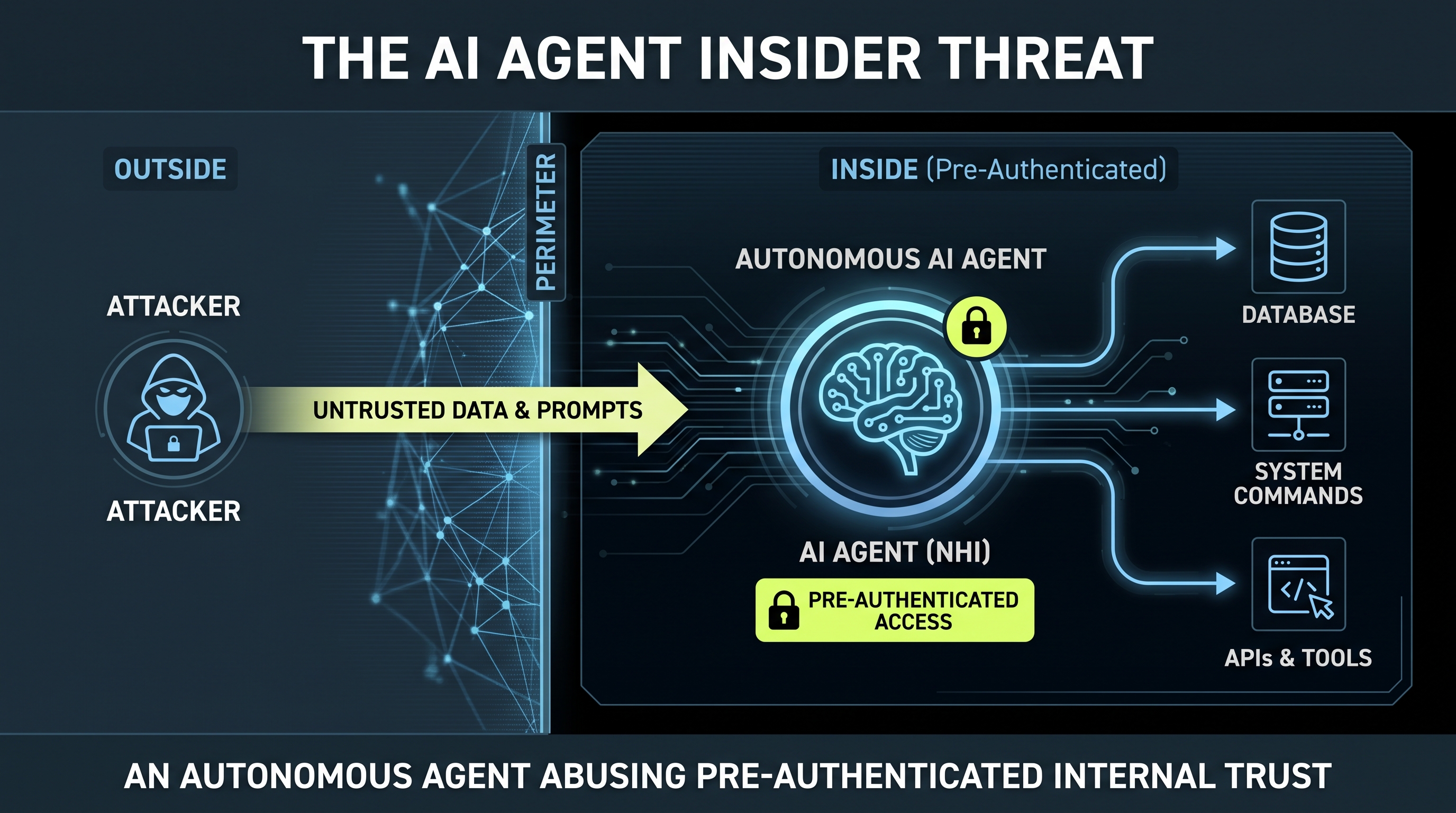
Traditional insider threats involve disgruntled employees exfiltrating intellectual property or credential compromise through spear-phishing. The rapid enterprise rollout of agentic workflows has introduced a dangerous operational paradox: autonomous AI agents acting as non-human identities (NHIs) with excessive internal system privileges.
Unlike passive chatbots that simply summarize text, autonomous agents plan multi-step actions, query relational databases, execute bash commands, call external APIs, and coordinate with downstream tools without human intervention. When an attacker subverts an agent's logic through untrusted data, the agent does not breach the perimeter from the outside. Instead, it abuses its legitimate, pre-authenticated access from within, becoming a high-velocity AI agent insider threat.
Anatomy of an Autonomous Agent Hijacking
Traditional software systems maintain strict boundaries between application code and operational data. Large language models and agentic workflows process instructions and external data within the exact same context window. This architectural reality creates three critical exposure vectors cataloged under the OWASP Top 10 for LLM Applications:
1. Indirect Prompt Injection (LLM01)
Attackers do not need direct access to the prompt window. By embedding adversarial instructions inside customer support tickets, supplier invoices, or retrieved RAG documents, attackers hijack the agent during routine data processing. Real-world vulnerabilities such as EchoLeak (CVE-2025-32711) proved that an unread email can trigger zero-click data exfiltration in enterprise copilots.
2. Excessive Agency and Privilege Creep (LLM03/LLM06)
Developers often assign broad administrative service accounts to agents to reduce integration friction. When an autonomous agent with broad read/write access to internal cloud storage executes an injected payload, it leverages legitimate organizational credentials to download sensitive buckets, bypass perimeter firewalls, and evade anomaly detection.
3. Compromised Tooling and Protocol Integrations
The emerging agent supply chain—including third-party tools and Model Context Protocol (MCP) servers—presents a widespread lateral movement vector. Malicious packages targeting tool integrations have demonstrated how attackers can hijack outgoing communication channels directly under SOC monitoring.
Technical Architecture: Defense-in-Depth for AI Agents
| Security Layer | Architectural Vulnerability | Enforced Mitigation |
|---|---|---|
| Identity & Access | Broad service account tokens, static API keys | Ephemeral OAuth credentials, strict attribute-based access control (ABAC) |
| Execution Control | Direct shell execution, unlimited tool calling | Sandboxed microVMs, egress traffic filtering, token throttling |
| Output Handling | Blindly executing agent-generated commands | Mandatory Human-in-the-Loop (HITL) for destructive mutations |
| Data Ingestion | Ingesting uninspected external documents | Dual-LLM validation: separating instruction ingestion from data parsing |
Enforcing Ephemeral Least Privilege
Under guidance outlined by the NIST AI Agent Standards Initiative, AI agents must never hold persistent, multi-tenant administrative tokens. Scope credentials to isolated execution sessions. If an agent triages support tickets, its API token must strictly permit reading ticket text—not writing database records or invoking network sockets.
Human-in-the-Loop (HITL) Guardrails
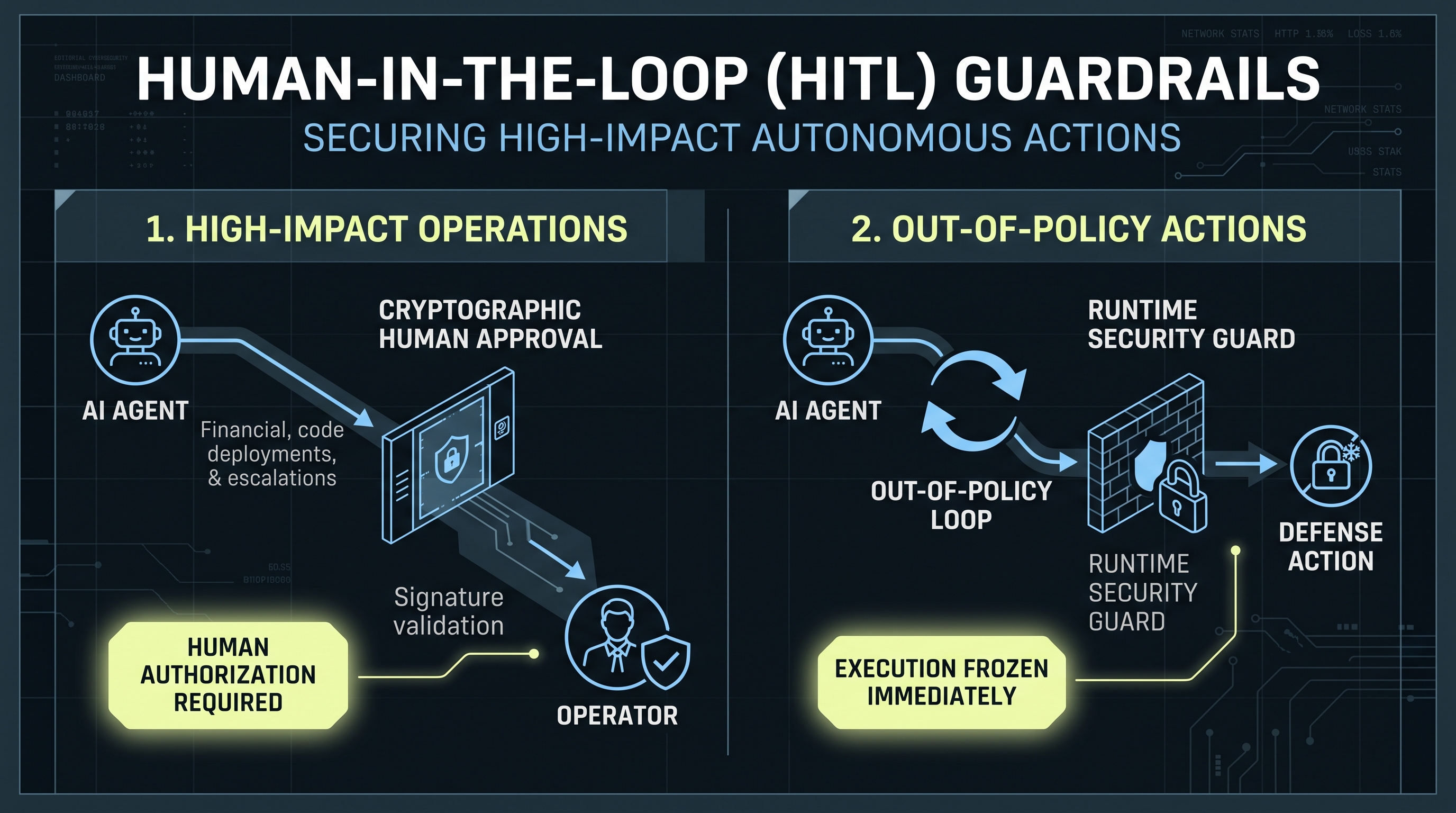
High-impact operations—including financial transactions, production codebase deployments, permission escalations, and bulk email distributions—must require cryptographic approval from an authorized human operator. If an agent attempts to execute an out-of-policy command loop, runtime security must freeze execution immediately.
Validating Agent Defenses Through Simulation and Hands-On Labs
Theoretical risk assessments cannot predict how complex multi-agent architectures behave under adversarial manipulation. Defending against autonomous insider threats requires continuous offensive validation through specialized lab environments:
- Prompt Injection Sandboxing: Deploying simulated agents against adversarial prompt injections inside isolated, containerized environments to identify logic hijacking before deployment.
- Evaluating Security Talent: SOC teams and security engineers must be evaluated on practical AI incident triage. Using cybersecurity applicant assessment labs enables organizations to test whether prospective security analysts can detect compromised non-human identities, intercept malicious API tool calls, and contain compromised automated workflows.
- Adversarial Red vs. Blue CTFs: Organizations hosting internal security exercises can run specialized scenarios using on-demand Docker instances. With Simulations Labs, engineering leaders can host automated, secure challenges to train defensive teams against autonomous agent exploits without managing complex server infrastructure.
Reviewing real-world deployments in published cybersecurity case studies demonstrates how hands-on, scenario-driven testing reveals system blind spots far faster than static code reviews.
Best Practices to Prevent AI Agent Misuse
- Treat Agents as Non-Human Identities (NHIs): Register every autonomous agent in your Identity and Access Management (IAM) directory with unique, monitorable telemetry streams.
- Isolate Execution Environments: Run tool-calling agents inside ephemeral containers that destroy the runtime upon task completion.
- Inspect Intermediate Reasoning Chains: Monitor internal agent reasoning tokens and API payloads for anomalous tool-invocation loops before changes commit to production systems.
- Conduct Continuous Red-Teaming: Incorporate adversarial prompt testing and agent-hijacking scenarios into standard DevSecOps pipelines.
Organizations seeking to build resilient teams capable of detecting compromised autonomous systems can launch practical, containerized cybersecurity challenges in minutes. Explore our detailed technical simulation guides or schedule a live platform demo to see how Simulations Labs equips your engineers to defend modern architectures.
Frequently Asked Questions
Q: What makes an AI agent an insider threat?
An AI agent functions as an insider threat because it possesses authenticated internal credentials, API access, and operational trust within the corporate perimeter. If compromised by indirect prompt injection or adversarial tool-calling, the agent acts using its pre-approved permissions to access, modify, or exfiltrate sensitive data.
Q: What is the primary difference between prompt injection and indirect prompt injection?
Direct prompt injection occurs when a human user enters malicious prompts directly into an interface to bypass safety guidelines. Indirect prompt injection occurs when an autonomous agent ingests external, untrusted content (like a poisoned webpage, email, or PDF) containing hidden instructions that hijack the agent's behavior during automated processing.
Q: How does excessive agency amplify agent security risks?
Excessive agency occurs when an AI agent receives more authority, tooling, or permissions than required to complete its job. If the agent's decision logic is manipulated, excessive agency allows the compromised agent to execute destructive commands, alter production databases, or exfiltrate files without operational friction.
Q: Can conventional Firewalls and EDR tools detect compromised AI agents?
Traditional firewalls and Endpoint Detection and Response (EDR) tools often miss agent compromise because the agent's actions use legitimate, authenticated API calls and legitimate system privileges. Detecting these attacks requires monitoring application-layer tool invocations, token consumption anomalies, and agent reasoning behavior.
Q: What is Human-in-the-Loop (HITL) architecture in agent security?
Human-in-the-Loop is a defensive design pattern where high-risk actions—such as sending funds, deleting data, updating system permissions, or executing arbitrary system scripts—require manual verification and cryptographic approval from a human administrator before execution.
Q: How can security teams practice defending against autonomous agent attacks?
Security teams can leverage containerized cybersecurity simulations and CTF-style environments. These platforms spin up isolated sandboxes where engineers practice intercepting malicious API interactions, detecting prompt injection payloads, and enforcing least-privilege guardrails under realistic operational conditions.