Short answer: no, not by default, but the more useful question isn't whether to trust it; it's what kind of verification makes trust unnecessary. Veracode's 2026 GenAI Code Security Report found that roughly 44% of AI code-generation tasks introduce a real security vulnerability, with an average security pass rate across 100+ tracked models sitting at just 56%, a figure that's barely moved in two years despite major gains in raw coding capability. At the same time, developer adoption of AI coding tools has climbed past 84%. Adoption climbed to near-universal while the evidence for blind trust never really arrived, which makes the honest answer more complicated than a yes or no.
-
The Case for Extending Some Trust
It would be dishonest to frame this as AI-generated code being uniquely bad. Human-written code has vulnerabilities too; that's the entire reason secure coding and code review exist as disciplines in the first place. AI assistants genuinely catch things developers miss under time pressure, generate reasonable boilerplate faster than a person would type it, and, for non-security-critical code, low-stakes internal tooling, and well-understood patterns, routinely produce output that's perfectly serviceable. The productivity case for these tools is real, and it's a large part of why adoption climbed as fast as it did.
There's also a version of "trust" that's simply about calibrated confidence rather than blind acceptance, and plenty of developers already practice something close to that instinctively, treating AI suggestions as a fast first draft rather than a final answer.
-
The Case Against Trusting It by Default
The evidence against unconditional trust is stronger and more specific than "AI sometimes makes mistakes."
The vulnerability rate is not improving as fast as capability is. Even as models have gotten dramatically better at producing functionally correct code, the rate at which that code introduces security flaws has stayed roughly flat, 56% today versus 55% in the very first report Veracode ran, even as syntax correctness across the same models sits above 95%.
Developers extend more trust than the evidence supports. A widely cited Stanford study found developers using an AI coding assistant not only wrote significantly less secure code than developers working without one, but were more likely to believe their code was secure, a pattern the researchers explicitly termed a "false sense of security." That's not a knowledge problem; it's a documented mismatch between confidence and accuracy, in exactly the direction that makes vulnerabilities more likely to ship unnoticed.
Security awareness and secure output aren't the same thing inside these systems. A systematic analysis synthesizing multiple studies on AI-generated code security found that models frequently lack defensive programming constructs and produce subtly incorrect implementations of security-critical logic, not because the underlying concept is unfamiliar to the model, but because generating secure code under normal conditions and generating plausible, prompt-satisfying code are handled differently by the system, and the second one wins by default. That undercuts the assumption that better models, or more security training data alone, will eventually solve this on their own.
Fixes tend to be narrow, not contextual. Even when a model is explicitly asked to secure a piece of code, it tends to fix exactly what was flagged and leave related issues in the surrounding logic untouched, because it's reasoning about the specific instruction, not holding a full picture of the system that instruction lives inside.
Put together, this isn't an argument that AI-generated code is untrustworthy in some abstract sense. It's an argument that trust calibrated to how confident or polished the output looks is measurably the wrong instinct, since confidence and correctness aren't linked in these systems the way they are in an experienced colleague's work.
-
What Calibrated Trust Actually Looks Like
The most defensible position isn't "trust it" or "never trust it", it's trust that varies deliberately by what's at stake:
-
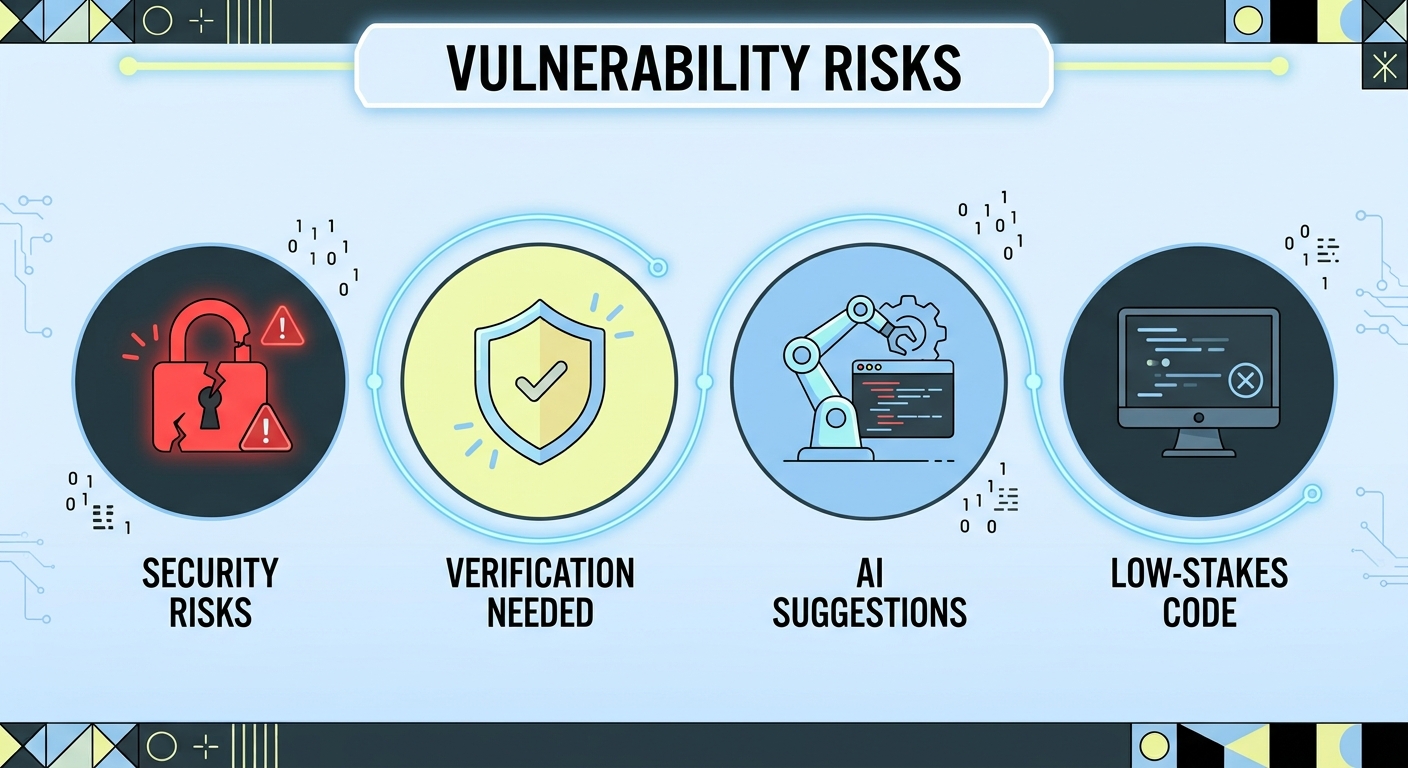
Low-stakes, non-security-critical code (internal scripts, boilerplate, UI scaffolding): reasonable to accept with a normal level of review.
-
Anything touching authentication, authorization, cryptography, or dependency management: treat as requiring mandatory, deliberate human verification every time, regardless of how routine the request seemed or how clean the output looks.
-
New dependencies an AI assistant suggests: verify they actually exist and are legitimately maintained before installing, a real and exploitable gap (hallucinated packages, and the "slopsquatting" attacks built around them) that has no equivalent in human-written code.
-
Anything presented with high confidence: apply more scrutiny, not less. Confidence in these systems isn't correlated with correctness, and unlearning the instinct to relax when output looks polished is one of the more valuable habits a developer can build. This is exactly the kind of judgment hands-on secure coding assessment is designed to test for, rather than a written quiz on definitions.
The Question That Actually Matters More
Here's the reframe worth sitting with: "Should I trust this code?" is fundamentally a question about the source. "Has this application actually been tested against realistic attack conditions?" is a question about the outcome, and it's the one that stays useful regardless of whether a human, an AI, or some mix of both wrote the code in question. Organizations that build real verification into their process- hands-on testing of the actual application, not just review of the code that produced it- don't need a confident answer to the trust question, because they've made the answer empirically checkable instead of a judgment call.
That's the posture platforms like Simulations Labs are built to support: live, hands-on Web Security environments where the question isn't whether a developer trusts a piece of code, but whether they can actually find what's wrong with it, which is a test that works the same whether the code came from a human, a model, or both.
Want to see how your team's judgment holds up against real, AI-relevant vulnerabilities? Try Simulations Labs and put the question to an actual test instead of a policy debate.
-
FAQ
Is AI-generated code always less secure than human-written code? Not always, but the data consistently points in the same direction: Veracode's 2026 benchmark puts the vulnerability rate in AI-generated code at roughly 44%, with an average security pass rate around 56% across 100+ models tested, meaningfully worse than well-reviewed, security-conscious human code, even though plenty of unreviewed human code is flawed too.
Does better prompting solve the trust problem? It helps, but it doesn't close the gap entirely. Prompts that explicitly ask for secure practices tend to produce safer code than vague requests, since AI-generated security is largely opt-in rather than a default. But even Veracode's testing methodology, which evaluates models with no security-specific prompting at all, suggests a meaningful share of the gap sits in default model behavior, not just in how developers phrase requests.
Should companies ban AI coding tools until this is solved? Most security researchers don't recommend that. The productivity gains are real, and banning the tools tends to push usage underground rather than eliminate it. The more practical approach is tiered scrutiny, light-touch review for low-stakes code, mandatory human verification for anything touching authentication, authorization, or cryptography, and dependency checks before installing anything an AI assistant suggests.
How can a company actually verify whether its developers can catch AI-introduced vulnerabilities? Completion of a training module doesn't answer this; it only shows attendance. The more reliable method is putting developers into a live, realistic environment with a real, unlabeled vulnerability and seeing whether they find and fix it. Simulations Labs' applicant and employee assessment model is built around exactly this kind of hands-on verification, tracked over time rather than relying on self-reported confidence.
Will this problem get better as AI models improve? Not necessarily on its own. Veracode's tracking shows vulnerability rates in AI-generated code have stayed roughly flat, 56% today versus 55% at the start of their testing program, even as functional capability and syntax correctness have improved substantially over the same period. That suggests security isn't simply a byproduct of general model improvement; it likely requires models, and the people using them, to specifically prioritize it.
Ready to see how your team's judgment actually holds up? Explore Simulations Labs and put developer skill to a real test instead of a policy debate.