If you're evaluating CTF hosting options, you're probably trying to answer a practical question: should your organization use a traditional CTF platform like CTFd, or choose a managed platform built for modern cybersecurity training, cybersecurity simulations, and assessment workflows?
For universities, training centers, startups, SMEs, and enterprises, the right choice depends on more than just challenge delivery. You also need to think about setup time, infrastructure overhead, scalability, learner experience, reporting, and how well the platform supports use cases like hands-on teaching, talent assessment, applicant screening, and internal hiring assessment.
In this guide, we compare CTFd and Simulations Labs across the areas that matter most — so you can decide which platform fits your organization today and can still support your growth tomorrow.
At a Glance: CTFd vs Simulations Labs
Here is the short version:
- CTFd is a well-known open-source platform for running capture the flag competitions, especially for technically capable teams that want flexibility and are comfortable handling setup, hosting, and customization.
- Simulations Labs is a fully managed SaaS platform designed to help organizations launch cybersecurity labs, simulations, and CTF events quickly — without infrastructure headaches, DevOps overhead, or engineering complexity.
If you want maximum control and have the technical resources to build around the platform, CTFd may work well.
If you want to host CTF events, labs, and assessments with less operational burden and faster deployment, Simulations Labs is a compelling alternative to CTFd.
CTFd vs Simulations Labs: The Core Differences
1. Infrastructure and Setup
This is usually the biggest decision point.
With CTFd, your team may need to provision servers, configure the environment, deploy challenges, secure the platform, and prepare for traffic spikes. If you already have DevOps support, that may be acceptable. If not, it quickly becomes a significant hidden cost.
With Simulations Labs, the platform is fully managed for you. Organizations can host CTF events and cybersecurity labs without handling server setup, maintenance, or security monitoring.
| CTFd | Simulations Labs | |
|---|---|---|
| Server provisioning | Team-managed | Fully managed |
| Security monitoring | Team-managed | Built-in |
| Scaling for large events | Manual planning required | Handled automatically |
| Time to launch | Hours to days | Minutes |
Best fit:
- CTFd: Teams that want more direct technical control
- Simulations Labs: Teams that want speed, simplicity, and reduced operational risk
2. Challenge Deployment and Hands-On Teaching
Not every organization wants simple static tasks. Many need immersive, practical environments for hands-on teaching and applied learning.
Simulations Labs supports:
- On-demand labs — provisioned when students click start; students receive a link or IP address immediately
- Docker-based challenges — deployed and isolated automatically
- Downloadable labs — such as PCAP analysis files for forensics and network security exercises
- Multiple challenge categories for realistic skill-building: Web Security, OSINT, Malware Reverse Engineering, Digital Forensics, Network Security, Cryptography, and more
This makes it especially attractive for universities and training centers delivering structured cybersecurity education.
CTFd can support many formats too, but turning it into a full practical lab environment may require significant additional engineering work depending on your setup.
**3. Monitoring and Analytics""
.png)
Running a good event is one thing. Understanding performance is another.
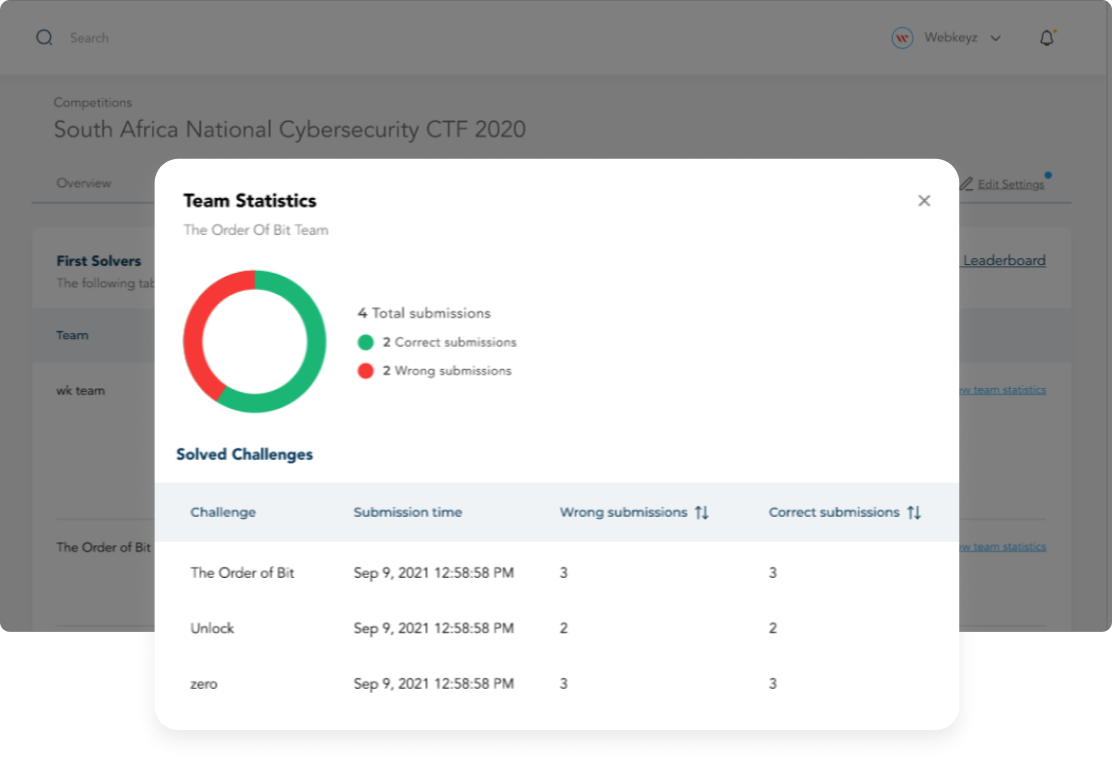
Simulations Labs includes real-time dashboards and post-event analytics such as:
- Participant and team progress tracking
- First solvers per challenge
- Most frequent wrong attempts (highlighting difficult challenges)
- Solver percentages per challenge
- Exportable reports in CSV, Excel, or PDF
These features are useful not only for event operations, but also for talent assessment and curriculum improvement. If your goal is to use cybersecurity labs as a measurable training or screening system, built-in reporting is essential.
4. Use Cases Beyond Competitions
CTFd is closely associated with classic CTF events. That is valuable, but some organizations need more than competition.
Simulations Labs is positioned for a broader set of operational use cases, including:
- University labs and student exercises across cohorts
- Bootcamps and training programs for skill development
- Internal employee upskilling and security awareness activities
- Applicant assessment and hiring assessment using hands-on cybersecurity challenges
- Community events and sponsored public competitions
- Company branding — white-label CTF competitions that showcase technical expertise to prospects
When CTFd Makes Sense
CTFd may be the better choice if:
- You have a technical team that can manage hosting and ongoing operations
- You want deeper customization and full control over the platform
- You mainly run classic CTF events rather than broader simulation programs
- You are comfortable piecing together supporting workflows yourself
This is especially true for security clubs, highly technical communities, or organizations with mature internal engineering support.
When Simulations Labs Makes Sense
Simulations Labs is likely the better fit if you want to:
- Launch faster with minimal setup — operational in minutes
- Run recurring cybersecurity labs and training programs
- Support hands-on teaching at scale across students or employees
- Use simulations for talent assessment and hiring assessment
- Access a ready-made challenge library via the Simulation AI Copilot
- Get built-in monitoring, analytics, and reporting out of the box
- Avoid DevOps, server maintenance, and security overhead
For many organizations, the question is not whether they can self-manage a platform — it is whether they should.
That is the main reason Simulations Labs stands out as a practical, scalable alternative to CTFd.
Final Verdict: CTFd vs Simulations Labs
Both platforms can support strong cybersecurity, but they operate on different models.
Choose CTFd if your organization wants technical flexibility and has the internal resources to manage the full stack.
Choose Simulations Labs if your organization wants a scalable, easier way to run CTF hosting, cybersecurity simulations, cybersecurity training, and assessments — without infrastructure friction, without DevOps overhead, and with built-in analytics from day one.
For universities, training centers, startups, SMEs, and enterprises looking to move faster with less complexity, Simulations Labs is a compelling alternative to CTFd.
If you are exploring a more efficient way to launch labs, competitions, or assessments, you can get started for free, review the use cases, or request a product demo.
FAQs
What is the best alternative to CTFd for universities?
For universities that want less infrastructure work and more support for hands-on labs, Simulations Labs is a strong option. It supports managed hosting, on-demand labs, analytics, participant prerequisite filters, and easier deployment for recurring academic use — without requiring a dedicated DevOps team.
Can Simulations Labs be used for hiring and applicant assessment?
Yes. Simulations Labs is purpose-built for applicant assessment and practical candidate screening. Organizations can use cybersecurity simulations and hands-on lab challenges to evaluate real-world technical skills in a controlled environment — going far beyond what a CV or traditional interview can reveal.
Is CTFd better for classic capture the flag competitions?
CTFd remains a familiar choice for classic CTF events, especially when technical teams want direct control and deep customization. The right fit ultimately depends on your internal resources and operational goals.
How can I host CTF competitions without managing infrastructure?
A managed platform like Simulations Labs allows you to launch and run CTF events without handling servers, scaling, or maintenance. This is particularly useful for schools, training centers, and companies with limited DevOps capacity. The Simulations Labs Spotlight Program even provides free hosted events for eligible community organizers.
What makes cybersecurity simulations useful for training?
Cybersecurity simulations provide practical, hands-on learning that theory alone cannot replicate. Instead of reading about web application vulnerabilities, participants exploit them. Instead of studying forensics, they analyze real PCAP files. This applied learning model produces more competent, job-ready professionals in areas like web security, digital forensics, OSINT, and network security.
What is the Simulation AI Copilot in Simulations Labs?
The Simulation AI Copilot is an AI-powered feature that gives users access to a large library of ready-made cybersecurity challenges. It enables non-technical users to create and deploy professional-grade simulations quickly and easily — without needing to build challenges from scratch or have deep technical expertise.
Does Simulations Labs support reporting and analytics?
Yes. The platform includes real-time monitoring, participant performance analytics (including first solvers, wrong attempts, and solve percentages), and exportable reports in CSV, Excel, or PDF format — supporting both competition management and post-event evaluation for training or hiring workflows.
What hosting options does Simulations Labs offer?
Simulations Labs supports three hosting modes: SaaS (fully managed cloud deployment), Private Hosting (dedicated infrastructure for your organization), and Local Hosting (on-premises deployment for organizations with strict data locality requirements).