The modern cybersecurity hiring funnel has become a marathon: a recruiter screen, a hiring-manager call, a technical deep-dive, a panel, a culture round, and a final conversation with leadership. Six rounds, five-plus hours of calendar time per candidate, weeks of elapsed time — and at the end of it all, one stubborn question remains:
Can this person actually do the work?
Interviews are excellent at measuring how candidates talk about security. They are remarkably poor at measuring how candidates perform in security. Those are different skills, and confusing them is the most expensive mistake in technical hiring.
What six rounds actually measure
Each interview round samples roughly the same surface: communication, confidence, recall, and how well a candidate has rehearsed common questions. By round four, you're not gathering new signal — you're gathering more opinions about the same signal. Meanwhile, the qualities that determine on-the-job success — methodology, tool fluency, persistence, prioritization under time pressure — never get observed at all, because conversation can't surface them.
A live, hands-on simulation flips this. Put a candidate inside a realistic environment — a vulnerable application, suspicious network traffic, an incident waiting to be triaged — and within one hour, observable behavior replaces self-description.
The signals that only a live environment can surface
Methodology under ambiguity. Real security work rarely starts with a clear question. Watching how a candidate orients — what they enumerate first, which hypotheses they form, what they rule out — reveals their actual thought process, not a narrated version of it.
Tool fluency. Anyone can name the right tool in conversation. Inside an environment, you see whether their hands know it: command speed, comfort in the terminal, how naturally they pivot when the first approach fails.
Persistence vs. panic. The most predictive moment in any assessment is the moment after failure. Some candidates iterate calmly; others freeze. No interview question reproduces that moment. Every simulation does.
Prioritization under time pressure. With limited time and multiple objectives, candidates must choose what matters most — exactly the judgment a real incident demands.
Honest skill depth. With submission tracking and real-time leaderboards, you see precisely which tasks each candidate solved, in what order, and how long each took — a skills profile no résumé or reference call can fake.
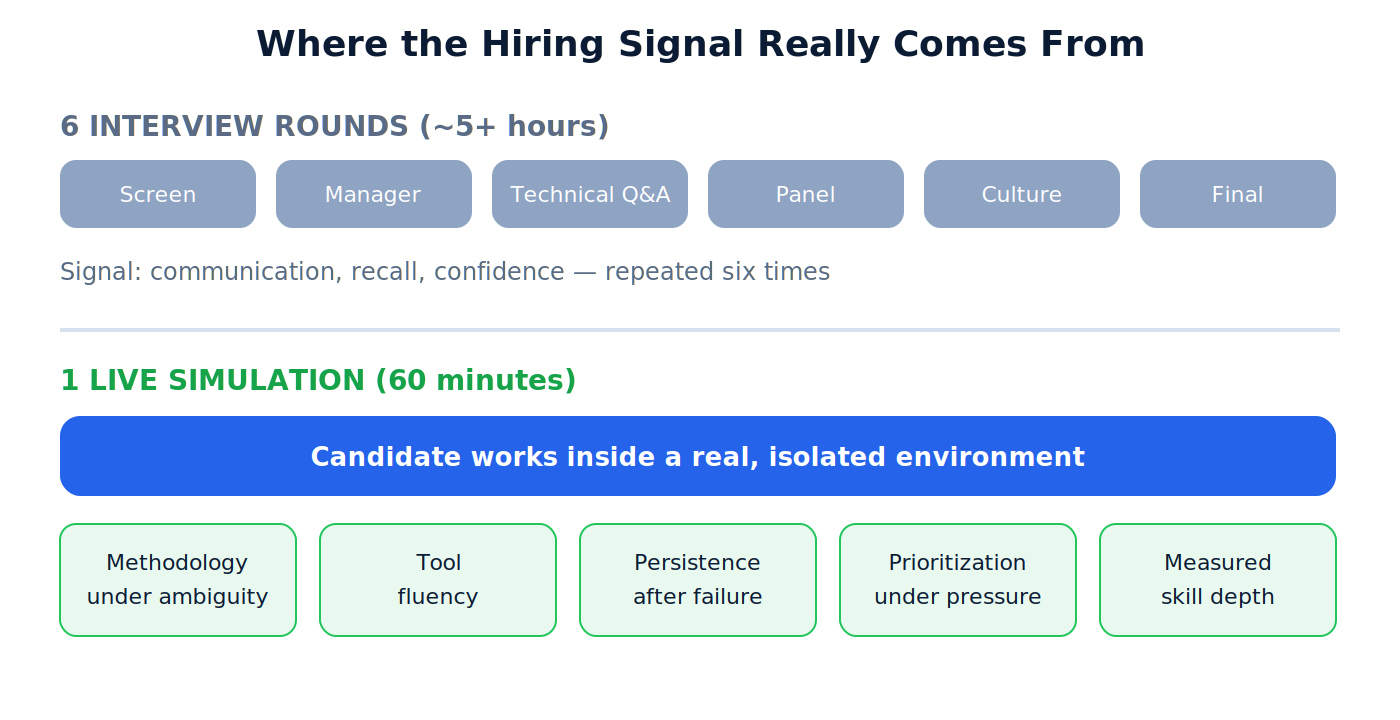
Figure 1 — Six rounds resample the same conversational signal; one hour of live work surfaces five new ones.
It also fixes the funnel math
Interviews are sequential and expensive — one candidate, several interviewers, repeated six times. A simulation is parallel: invite twenty candidates into the same timed event, each in their own isolated environment, and rank everyone on identical evidence in a single afternoon. The same standardization that makes results comparable also makes them defensible — every candidate faced the same scenario, scored by the same rules.
That doesn't mean interviews disappear. It means they move to the end, where they belong — a focused conversation with two or three finalists whose abilities you've already verified, instead of six rounds of guessing.
Getting started takes less than the first interview round
You don't need to design scenarios yourself. With Simulations Copilot, describe the role — SOC analyst, penetration tester, security engineer — and instantly get expert-built, role-relevant scenarios from our library, ready to deploy in your assessment event. Setup is no-code from start to finish, with analytics and reports delivered when the clock stops.
Six rounds tell you who interviews well. Sixty minutes tells you who works well. Hire on the second one.
Replace guesswork with evidence
Run your first hands-on candidate assessment this week. Get Started for Free — no credit card required.