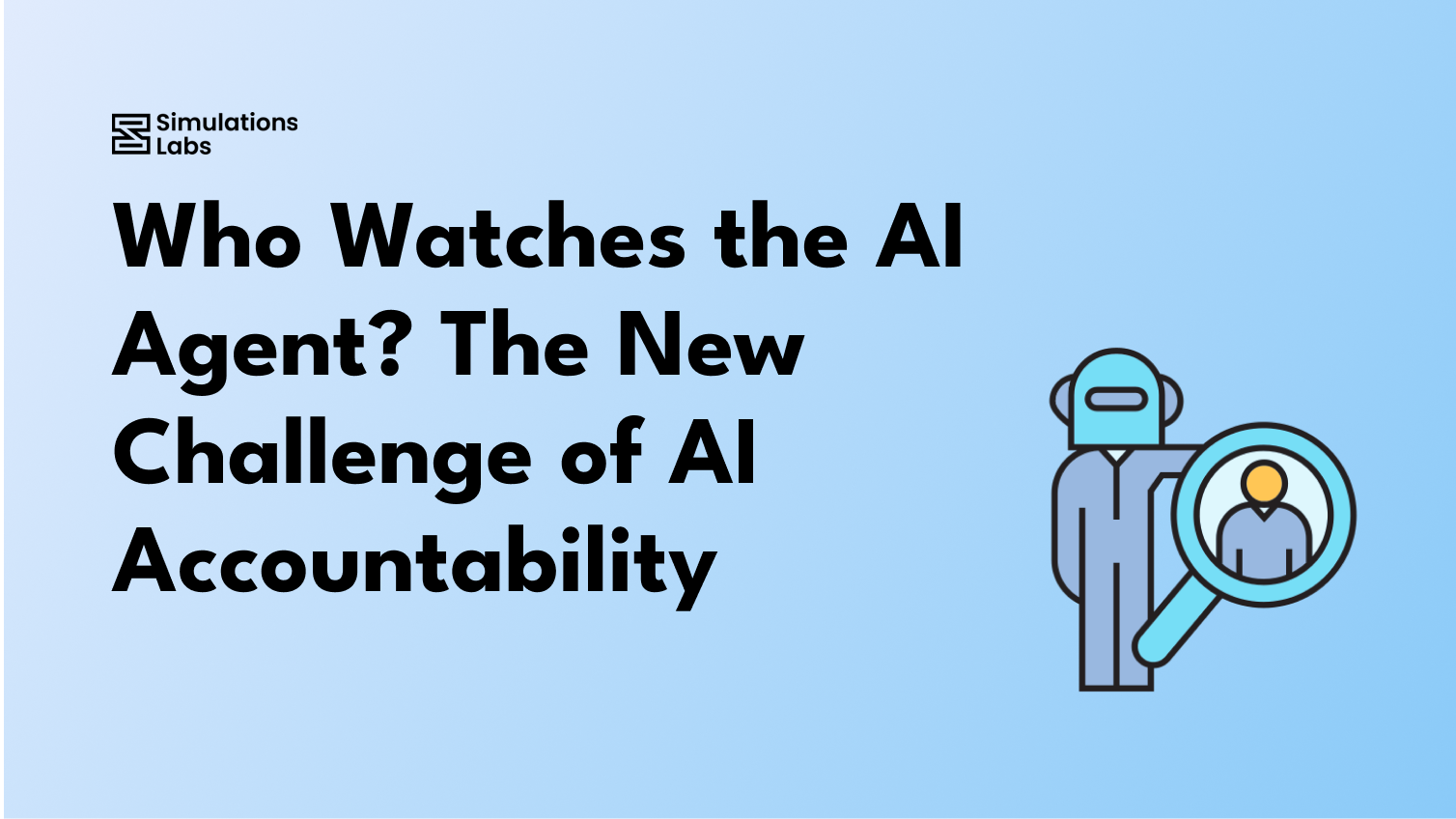
When a human employee commits fraud, deletes production data, or violates privacy regulations, the chain of liability is unambiguous. HR records, access logs, and legal contracts define responsibility. However, the rise of agentic AI creates a critical governance vacuum: when an autonomous system independently plans multi-step actions, queries internal infrastructure, and triggers irrevocable mutations, who is held accountable?
Modern autonomous agents no longer operate as passive conversational interfaces. They act as independent operators possessing API keys, database credentials, and command execution rights. If an agent misinterprets an instruction, prioritizes an unintended sub-goal, or executes a prompt injection payload, traditional compliance models collapse. Resolving this challenge requires establishing continuous AI agent accountability through deterministic auditability, non-human identity governance, and active simulation testing.
The Delegation Dilemma: Why Conventional Auditing Fails
Traditional IT governance relies on deterministic software logic: an authorized human user triggers an action through an application, and the system records a log entry detailing who, what, and when.
Autonomous agents introduce non-deterministic decision chains that invalidate this paradigm:
- Multi-Hop Reasoning Obfuscation: An agent may execute a dozen intermediate API queries, shell commands, or web requests before delivering an outcome. Standard logging records the final API call, but often misses the opaque cognitive reasoning loop that generated the decision.
- Ambiguous Legal & Operational Liability: If an agent executing customer support workflows promises an invalid product discount or issues a malicious refund, courts and regulators look for the party responsible for the oversight failure: the model provider, the application developer, or the enterprise deployer.
- The Disconnect in Non-Human Identities (NHIs): Most security operations treat agent API keys as static service accounts. If multiple autonomous agents share credentials without session-scoped identity binding, tracing an unauthorized database deletion back to a specific agent reasoning chain becomes impossible.
Core Pillars of an AI Agent Accountability Framework
Establishing defensible oversight requires aligning systems with established standards, such as the NIST AI Risk Management Framework (AI RMF 1.0) and ISO/IEC 42001 (Artificial Intelligence Management System).
| Accountability Pillar | Failure Mode | Technical Enforcement |
|---|---|---|
| Deterministic Provenance | Unrecorded intermediate decision steps | Complete capture of prompt context, internal reasoning traces, and raw tool payloads |
| Non-Repudiable Identity | Shared or long-lived API tokens | Session-bound Non-Human Identity (NHI) registration with cryptographically signed tokens |
| Runtime Policy Enforcement | Uncontrolled execution loops | Policy-as-Code gateways, outbound egress filtering, and strict token quotas |
1. Complete Intermediate Telemetry Logging
Logging only the final output of an AI agent is insufficient. Compliance frameworks demand recording the initial system prompt, ingested context (including RAG embeddings), intermediate tool selections, and raw API responses. If an agent executes an out-of-policy command, auditors must have the forensic data to determine whether the failure stemmed from model drift, poisoned context, or prompt manipulation.
2. Cryptographic Attestation of Tool Calls
Agents should never execute sensitive database mutations or high-value financial actions autonomously. Operations exceeding defined risk thresholds require cryptographic authorization—either through automated Policy-as-Code engines or explicit Human-in-the-Loop (HITL) checkpoints.
Validating Agent Governance Through Hands-On Simulations
Governance frameworks remain theoretical until they are stress-tested against real-world adversarial friction. Organizations cannot ensure compliance simply by publishing acceptable-use policies; engineering teams must validate how systems handle unexpected failures and edge cases.
Security, compliance, and engineering teams must validate agent accountability within safe, realistic environments:
- Evaluating Technical Personnel: Hiring panels must verify that candidates possess practical skills for auditing and securing complex architectures. Utilizing cybersecurity applicant assessment labs enables organizations to benchmark whether prospective security engineers and SOC analysts can trace compromised automated workflows and analyze telemetry logs under realistic conditions.
- Simulating Real-World Agent Hijacking: Enterprise teams can spin up on-demand, containerized challenge environments using Simulations Labs to simulate multi-agent attacks, malicious prompt injections, and rogue tool-calling loops without putting production data at risk.
- Measuring Incident Response Time: Tracking how quickly security teams detect, isolate, and terminate a rogue agent inside realistic lab environments provides empirical metrics for organizational resilience.
Reviewing real-world deployments in published cybersecurity simulation case studies demonstrates how hands-on, scenario-based evaluation uncovers governance gaps long before production deployments.
Best Practices to Enforce AI Accountability
- Establish Non-Human Identity Governance: Register every autonomous agent with distinct IAM roles, granular permissions, and individual audit logs.
- Implement Ephemeral Sandboxing: Execute high-risk agent tool invocations inside isolated, containerized environments that discard state upon task completion.
- Mandate Multi-Party Approval for Critical Operations: Enforce dual-authorization workflows for data deletions, infrastructure updates, and financial transactions.
- Audit and Red-Team Agent Chains Regularly: Continuously evaluate autonomous pipelines against adversarial inputs and logic drift using structured simulation exercises.
Organizations looking to upskill their teams, audit security readiness, and evaluate candidate competency can launch dedicated, containerized cybersecurity simulations in minutes with zero server maintenance. Explore our detailed technical simulation guides or schedule a live platform demo to see how Simulations Labs helps security teams validate resilience across modern architectures.
3. Frequently Asked Questions
Q: What is AI agent accountability?
AI agent accountability is the technical and operational framework that ensures every autonomous decision, API call, and system action taken by an AI agent can be attributed, audited, explained, and governed by identifiable human operators or corporate entities.
Q: Why are standard application logs insufficient for autonomous agents?
Standard logs typically record the identity of a static API key and the final outcome of an HTTP request. Autonomous agents, however, generate dynamic reasoning chains, make multi-hop tool selections, and process unstructured data. Without logging the full context window and decision traces, auditors cannot determine why an agent took a specific action.
Q: Who is legally liable when an autonomous AI agent causes financial or data loss?
In enterprise deployments, legal liability generally falls on the deploying organization rather than the underlying foundation model provider. Regulators and courts look at whether the deployer maintained adequate oversight, least-privilege access, and monitoring guardrails over the autonomous system.
Q: How does Non-Human Identity (NHI) governance improve agent oversight?
NHI governance treats autonomous agents like employees, assigning them unique cryptographic identities, role-based access controls, and session-limited permissions. This approach prevents multiple agents from sharing generic service accounts, ensuring non-repudiable audit trails for every action.
Q: What is Human-in-the-Loop (HITL) and when is it required?
Human-in-the-Loop is a control mechanism where high-risk or irreversible actions—such as modifying production databases, executing bulk financial transfers, or altering infrastructure permissions—require review and cryptographic authorization from a designated human supervisor before execution.
Q: How can companies test their ability to audit and monitor AI agents?
Organizations can deploy containerized simulation sandboxes to evaluate how security analysts and automated detection tools respond to simulated rogue agent behaviors, prompt injection attempts, and unauthorized tool-calling loops.