Walk into most cybersecurity classrooms, and you'll find the same problem: students who can recite the theory but freeze the moment they're asked to apply it. Slides and lectures build knowledge, but they rarely build the instinct to act under pressure — and they rarely build excitement.
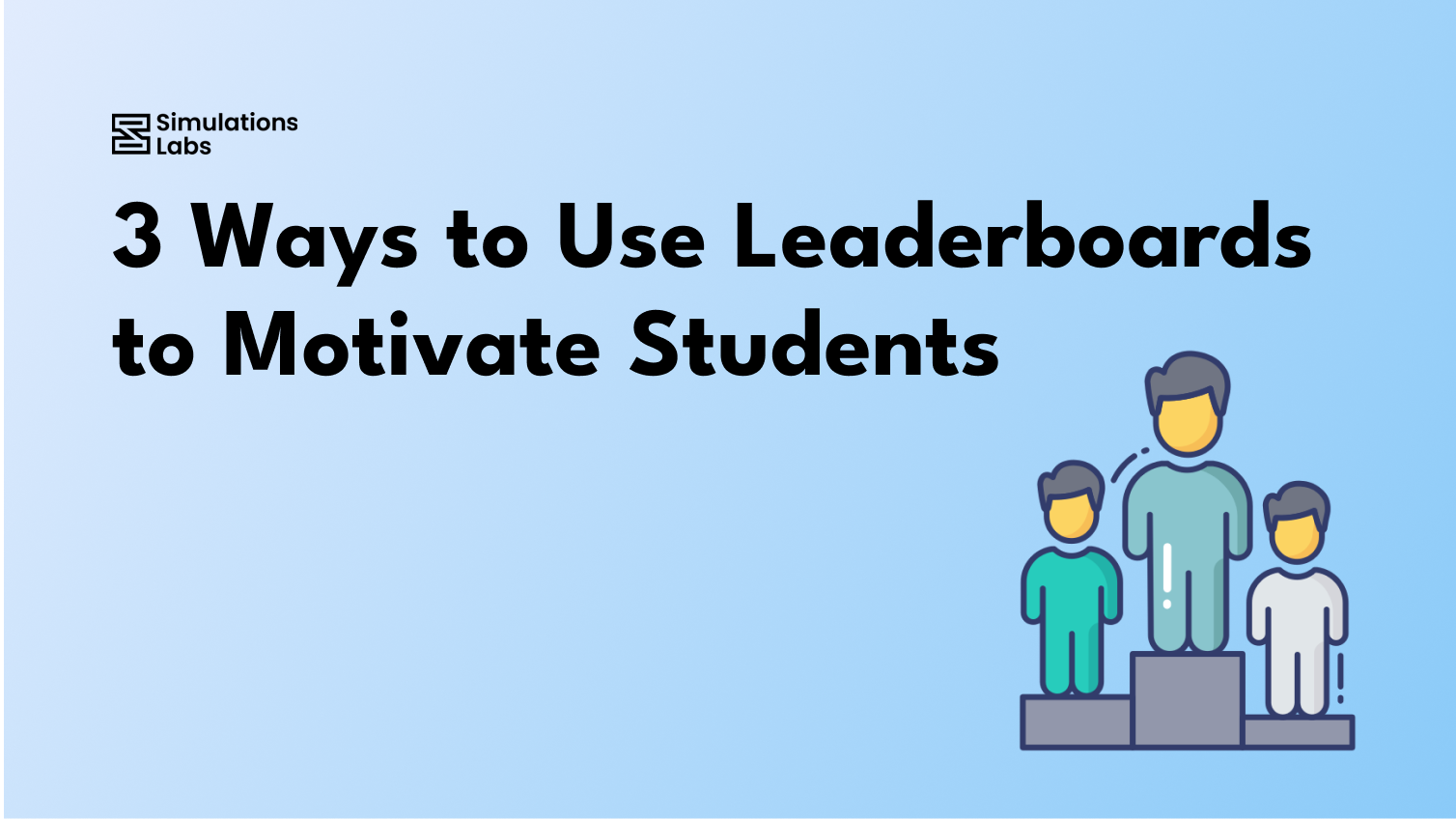
Leaderboards fix that. There's something deeply human about seeing your name move up a ranking in real time. It turns a solo exercise into a shared experience, and it turns "I should probably finish this lab" into "I need to solve one more challenge before Ahmed catches up." For cybersecurity educators, that energy shift is often the difference between a lab that gets half-finished and one that gets fought over. A systematic review of leaderboard research in higher education supports this: leaderboards are among the most widely used gamification elements in education, and — when well designed — they can meaningfully boost motivation, engagement, and academic achievement.
Here are three practical ways to use leaderboards to get more out of your students — and how a platform like Simulations Labs makes each one easy to run without touching a server.
1. Turn Individual Labs Into Friendly Competition
The simplest use of a leaderboard is also the most effective: take a lab your students are already doing and add a live ranking to it.
When a challenge has no visible ranking, a student who solves it feels a quiet sense of accomplishment — and moves on. When that same challenge has a leaderboard attached, solving it becomes a public event. Points appear next to their name, their rank shifts, and everyone in the room notices. That visibility changes behavior. Students who might have stopped after the first challenge instead ask, "what's the next one worth?"
This works especially well in a classroom setting where challenges map to what you're currently teaching. If this week's lecture covered SQL injection, a short web security challenge with a live leaderboard reinforces the concept immediately, while the ranking keeps everyone engaged until the last minute of class — not just the fastest few.
Simulations Labs' live leaderboard updates instantly as challenges are solved, showcasing rankings, points earned, and progress — which is exactly what you want for classroom labs. And because labs run directly in students' browsers, there's no setup required to turn a lecture into an interactive session; you can spin up a lab and a leaderboard in the time it would otherwise take to load a slide deck.
Design still matters, though. Research on leaderboard design in gamified learning environments suggests that the most effective leaderboards track progress over time rather than showing a single static rank — so students see themselves closing a gap, not just where they sit on a fixed list.
2. Run Team-Based Competitions to Build Collaboration Skills
Real cybersecurity work rarely happens in isolation. SOC teams, incident response units, and pentesting engagements all rely on people with different strengths working together under time pressure. A leaderboard that ranks teams instead of individuals is one of the most effective ways to simulate that dynamic in a classroom.
Team leaderboards do something individual ones can't: they create internal accountability. A student might let a personal deadline slide, but they're far less likely to let their team down mid-competition. Mixing skill levels within teams also means stronger students naturally start mentoring weaker ones — not because you asked them to, but because the scoreboard gives them a reason to.
This format is especially well suited to end-of-course Capture the Flag events or capstone-style competitions, where students need to apply several skills — web security, forensics, cryptography — together rather than in isolated exercises. Simulations Labs supports this directly: the platform spans Web Security, OSINT, Malware Reverse Engineering, Digital Forensics, Network Security, Cryptography, and many more categories, so you can build a single competition that tests a broad, realistic skill set rather than one narrow topic. If you're planning your first one, the Host a CTF Competition page walks through how to set it up.
To keep team competitions fair, it also helps that each participant's flags are unique. Dynamic Flag Challenges assign unique flags to each player, preventing flag sharing and ensuring fair competition, and helping detect cheating — so a leaderboard actually reflects who did the work, not who copied an answer from a group chat.
3. Use Recurring Leaderboards to Build a Long-Term Cybersecurity Community
The biggest motivational gains don't always come from a single competition — they come from a leaderboard that persists across a semester, a club, or an entire program. When students can watch their progress accumulate over weeks or months, the goal shifts from "win this one CTF" to "become one of the strongest players on campus."
This is where leaderboards move from a classroom tactic to a retention strategy. A running leaderboard gives your cybersecurity club, student chapter, or elective course a reason for students to keep coming back between formal competitions. Top performers get recognition, which matters more to students than most instructors expect — a name at the top of a public ranking, or a certificate tied to strong standing, often does more for motivation than a grade ever could.
Getting Started Without the Infrastructure Headache
The reason most educators don't run more of these competitions isn't a lack of interest — it's that setting up servers, containers, and live scoring infrastructure is a project in itself, on top of an already full teaching load.
That's the gap Simulations Labs is built to close. Organizations can run CTFs and simulations without DevOps, server setup, or maintenance, and challenges can be sourced from a ready-made library using the Simulations AI Copilot, which gives non-technical users access to a large library of ready-made challenges to build simulations quickly. That means the leaderboard — and the motivation it creates — can be live in your classroom in minutes, not weeks.
Whether it's a single lab, a team-based capstone, or a semester-long ranking for your cybersecurity club, the mechanism is the same: give students something to watch move, and they'll work harder to move it.
Ready to try it? Explore the product demo, browse more guides on running effective competitions, or head to Simulations Labs' blog for more on cybersecurity education strategy.