Your SOC team has playbooks for ransomware. They’ve drilled phishing response until it’s muscle memory. They can spot lateral movement in their sleep. But here’s the question nobody’s asking loudly enough: what happens when the attacker isn’t a human sitting at a keyboard, but an AI agent operating autonomously inside your network?
Agentic AI—systems that plan, reason, and take independent action—is already deployed across enterprises for everything from code generation to customer service. And it’s creating an attack surface that most security operations centers have never rehearsed for.
What Makes Agentic AI Different from Traditional Threats
Traditional attacks follow patterns your SIEM can learn. An attacker scans, exploits, escalates, and exfiltrates. The cyber kill chain has steps, and each step has signatures. Agentic AI breaks that model in three ways.
First, agentic systems adapt in real time. They don’t follow a script. If one path to a resource is blocked, the agent reasons about alternatives. It’s not persistence in the malware sense—it’s persistence in the cognitive sense. The system is thinking its way through your defenses.
Second, their actions look legitimate. An AI agent querying a database, calling an API, or drafting an email doesn’t trigger the same alarms as a suspicious PowerShell script. The agent’s actions blend seamlessly with normal business operations because they often use the same tools your employees use.
Third, they move at machine speed. A full attack chain—from initial prompt injection to data exfiltration—can be completed in minutes. Your analyst hasn’t even finished their coffee before the damage is done.
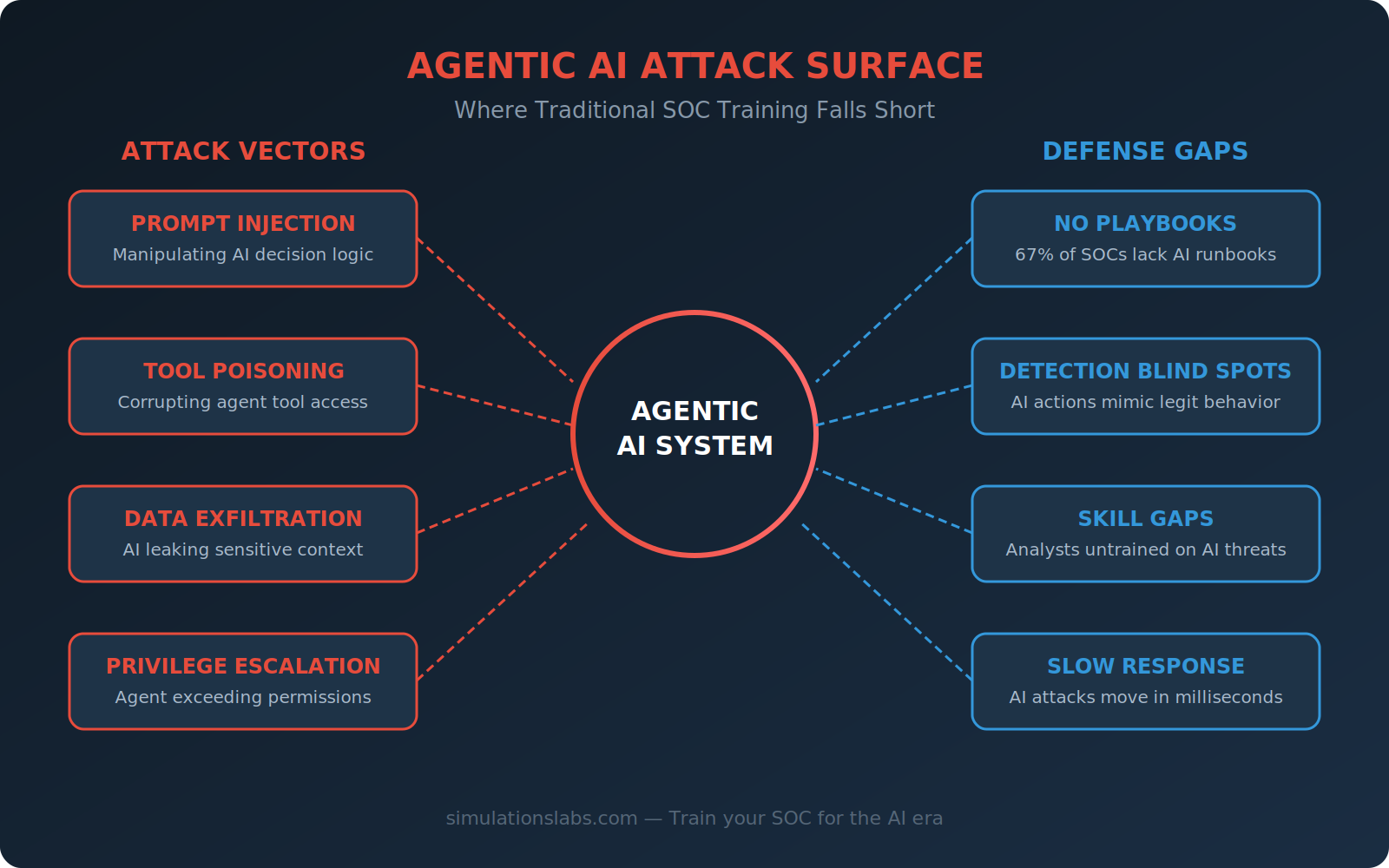
The Four Attack Vectors Your SOC Isn’t Watching
Prompt injection remains the most accessible attack vector against agentic systems. When an AI agent processes untrusted input—emails, documents, web content—a carefully crafted payload can hijack its instructions. Your SOC’s email security gateway doesn’t flag a prompt injection because it doesn’t look like malware. It looks like text.
Tool poisoning targets the APIs and integrations that agents rely on. If an attacker can compromise a tool in the agent’s chain—a plugin, a database connection, an external service—they control what the agent sees and does. The agent trusts its tools by design.
Context-based data exfiltration exploits the agent’s access to sensitive data. Agents often have broad permissions to be useful. An attacker who manipulates the agent’s reasoning can trick it into sending confidential information to external endpoints, framed as a normal business action.
Privilege escalation through chaining happens when agents combine multiple low-privilege actions into a high-impact sequence. No single action triggers an alert. The damage comes from the combination—something static rules almost never catch.
Why Your Current Training Program Misses This Entirely
Most SOC training programs were built for a world where attackers are human, and tools are deterministic. Analysts learn to read logs, correlate alerts, and follow decision trees. That’s necessary, but it’s no longer sufficient.
The challenge with agentic AI threats is that they require a different analytical mindset. Analysts need to understand how large language models reason, how tool-use chains work, and what abnormal agent behavior looks like in telemetry. They need to recognize when an AI system is being manipulated versus when it’s operating normally—and that distinction is genuinely subtle.
You can’t develop that intuition from a slide deck. You develop it from practice, from seeing simulated agentic attacks unfold in a controlled environment, from making the wrong call in a safe space so you make the right one when it matters.
How to Start Closing the Gap
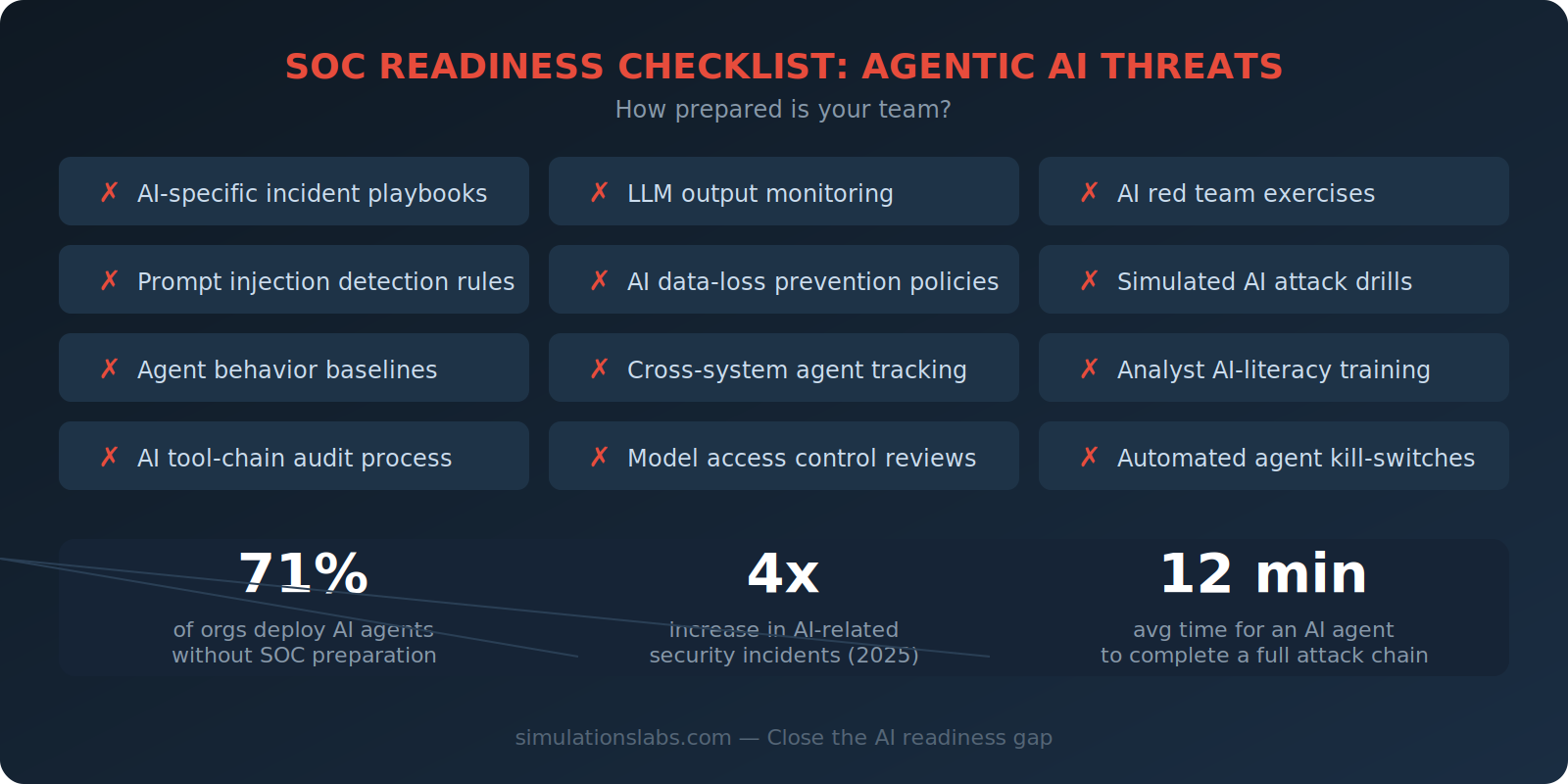
The fix isn’t theoretical. It’s practical. SOC teams need hands-on simulation environments where they can encounter agentic AI attack scenarios, practice detection and response, and build muscle memory for threats that don’t exist in yesterday’s training materials.
That means running tabletop exercises built around AI-specific scenarios. It means deploying simulated AI agents in controlled lab environments and tasking analysts with detecting their activity. It means updating your incident response runbooks to include agentic threat categories and training your team against them repeatedly.
At Simulations Labs, we build exactly these environments. Our simulation platform lets SOC teams practice against realistic agentic AI threats—prompt injections, tool-chain attacks, autonomous exfiltration—in scenarios that mirror real enterprise deployments. No slides. No theory. Just reps.
The Bottom Line
Agentic AI is already inside your organization. The only question is whether your SOC team has trained to defend against it—or whether they’ll be learning on the job during a live incident. The MITRE ATT&CK framework hasn’t fully mapped this territory yet. Your training needs to get ahead of it.
Ready to train your SOC for agentic AI threats? Visit Simulations Labs to explore our hands-on simulation platform.
FAQ
What is agentic AI in a SOC context?
Agentic AI refers to systems that can plan, reason, and take independent actions across tools, APIs, databases, and business systems. In a SOC context, this creates new security risks because these systems can operate autonomously inside enterprise environments.
Why is agentic AI a new attack surface?
Agentic AI introduces risks that traditional SOC playbooks may not cover. Unlike deterministic tools, agentic systems can adapt, make decisions, and interact with enterprise systems in ways that may look legitimate while still being malicious or manipulated.
How is agentic AI different from traditional cyber threats?
Traditional attacks often follow recognizable patterns such as scanning, exploitation, privilege escalation, and exfiltration. Agentic AI can adapt in real time, use legitimate tools, and move at machine speed, making it harder for standard detection rules to identify.
What are the main attack vectors against agentic AI systems?
The key attack vectors include:
- Prompt injection
- Tool poisoning
- Context-based data exfiltration
- Privilege escalation through chained actions
Each vector exploits the way AI agents process instructions, trust tools, access data, or combine actions.
What is prompt injection?
Prompt injection happens when an attacker uses malicious text inside emails, documents, websites, or other inputs to manipulate an AI agent’s instructions. Because it looks like normal text, traditional email or malware defenses may not detect it.
What is tool poisoning?
Tool poisoning targets the APIs, plugins, databases, or external services that an AI agent depends on. If an attacker compromises one of these tools, they can influence what the agent sees, trusts, and does.
How can agentic AI enable data exfiltration?
Agents often need broad access to data to be useful. Attackers can manipulate an agent’s reasoning so it sends sensitive information to external destinations while appearing to perform a normal business action.
Why is privilege escalation through chaining hard to detect?
In this scenario, an agent combines multiple low-risk actions into a high-impact sequence. Each individual action may look harmless, so static rules may miss the overall malicious chain.
Why do current SOC training programs miss agentic AI threats?
Most SOC training programs focus on human attackers, deterministic tools, log analysis, alert correlation, and predefined decision trees. Agentic AI threats require analysts to understand model behavior, tool-use chains, and abnormal AI-driven activity patterns.
How should SOC teams train for agentic AI threats?
SOC teams should use hands-on simulation environments, tabletop exercises, simulated AI agents, and updated incident response runbooks that include AI-specific attack scenarios such as prompt injection, tool-chain attacks, and autonomous exfiltration.
Can slide-based training prepare teams for agentic AI threats?
Not effectively. The blog argues that analysts need repeated practice in controlled simulation environments to build intuition and response skills for subtle AI-driven threats.
How does Simulations Labs help with this challenge?
Simulations Labs provides hands-on simulation environments where SOC teams can practice against realistic agentic AI threats, including prompt injections, tool-chain attacks, and autonomous data exfiltration scenarios.
What is the key takeaway for security leaders?
Agentic AI is already entering enterprise environments, but many SOC teams have not trained for the risks it creates. Organizations should prepare now through realistic simulations instead of waiting to learn during a live incident.