There is a version of cybersecurity training that organisations buy out of obligation. It checks a compliance box, gets assigned to the whole company at the start of the year, and is quietly resented by everyone who has to sit through it. Security teams know this content is not changing behaviour. HR knows it. The employees certainly know it. And yet the cycle continues.
Then there is the other version — the kind that actually builds a security culture. The difference between the two is not budget or branding. It is whether the training is designed around how humans actually process risk, make decisions under pressure, and develop habits that stick.
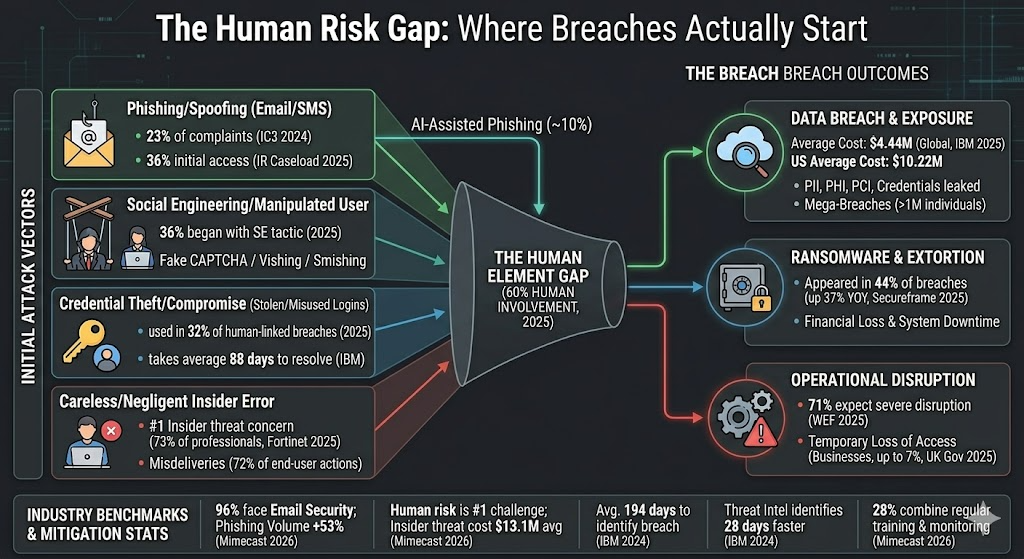
The human risk gap — the space between the security controls your organisation has in place and the decisions your employees make every day — is where the majority of breaches still originate. Closing that gap requires something different from what most compliance-focused programmes offer.
What Security Culture Actually Means
Security culture is not a feeling. It is not whether employees say they take security seriously on an internal survey. It is a set of observable, measurable behaviours: whether people report suspicious emails, whether they question unusual requests from leadership, whether they follow clean desk policies without being reminded, and whether they push back when a process feels off.
These behaviours do not emerge from annual training modules. They develop through repetition, reinforcement, and — critically — through environments where reporting a near-miss is seen as a contribution rather than an embarrassment. Building that environment is as much a leadership and communications challenge as it is a technical one, but training platforms play a central role in creating the conditions for it.
Why Simulation-Based Training Changes the Equation
The core problem with traditional security awareness content is that it addresses knowledge without addressing behaviour. Someone can watch a video explaining how phishing works, understand the concept entirely, and still click a malicious link two days later — because the knowledge was never tested under realistic conditions.
Simulation-based training disrupts this by putting people in situations that closely mirror real attacks. When an employee receives a simulated phishing email that mimics a genuine vendor invoice, their response is not a quiz result — it is a behavioural data point. When they report it to the security team rather than clicking, that is a cultural indicator. When they do click but then receive immediate, contextual feedback about why that particular email was suspicious, that feedback loop is far more effective than any retrospective training module could be.
The research on this is fairly consistent: spaced repetition, immediate feedback, and realistic context produce measurably better retention and behaviour change than passive content delivery. Simulation platforms are, at their best, applied behavioural science.
Personalisation Is Not a Feature — It Is a Requirement
One of the limitations of legacy training programmes is that they treat an organisation as a single audience. A 60-year-old finance director and a 24-year-old developer face fundamentally different threat profiles and have very different relationships with technology. Sending them the same phishing simulation templates and the same training modules is a wasted opportunity.
Modern training platforms worth their cost should be doing department-level and role-based targeting. Finance teams should be receiving business email compromise scenarios. Executives should be seeing whale phishing simulations. New starters should be in a structured onboarding track that builds foundational awareness before more sophisticated campaigns begin. IT and technical staff need different content entirely — their risk exposure is different, and their tolerance for generic content is low.
Personalisation also means responding to individual performance data. An employee who consistently flags simulated phishing emails does not need the same reinforcement as one who has submitted credentials twice in the past quarter. Platforms that adapt to this — surfacing targeted micro-training based on actual behaviour — are the ones that move the needle on culture rather than just awareness.
The Manager Layer Nobody Talks About Enough
Security culture does not scale without managers. An organisation can have the best training platform in the market, but if line managers do not reinforce the right behaviours, model good security habits themselves, or create psychological safety around reporting mistakes, the cultural impact stays shallow.
This is an area where training platforms can do more than they typically do. Giving managers visibility into their team's performance — not to discipline, but to facilitate conversations — makes a meaningful difference. So does giving them simple, non-technical language to use when an incident happens on their team. The message from a manager after someone clicks a phishing simulation matters enormously. It can either reinforce reporting culture or suppress it for months.
The most effective security culture programmes we have seen pair simulation and training data with regular manager briefings and talking points. It is a small addition to a platform rollout, but the impact on reporting rates tends to be significant.
Measuring Culture, Not Just Awareness
If you want to know whether a security culture programme is working, look beyond training completion. The metrics that signal genuine cultural shift are: voluntary reporting rates (people flagging things they were not prompted to flag), near-miss disclosures, and how the security team is perceived internally — whether employees see them as enforcers or as allies.
These are harder to quantify than click rates, but they are worth tracking. An annual security culture survey, benchmarked over time and broken down by department and tenure, gives you a view that simulation data alone cannot provide. Pair that with your platform's behavioural metrics, and you have the foundation for a genuine programme assessment rather than a compliance audit.
The human risk gap will never close entirely. Social engineering, by definition, targets human judgment — and human judgment is not a system you can fully patch. But organisations that build genuine security cultures get closer to closing it than those that rely on annual tick-box training. The difference is whether your programme is designed to change what people do, or just what they know.
That distinction is what Simulations Labs is built around. And it is the one that makes all the difference when the real test arrives.
FAQ
What is the human risk gap in cybersecurity?
The human risk gap is the space between the security controls an organization has in place and the decisions employees make every day. Many breaches still originate from this gap, which is why security culture and behavior-focused training are essential.
What does security culture actually mean?
Security culture is not just a belief or survey response. It is reflected in observable behaviors, such as reporting suspicious emails, questioning unusual requests, following security policies, and speaking up when something feels wrong.
Why is annual compliance training not enough?
Annual training often focuses on checking a compliance box rather than changing behavior. Employees may understand security concepts but still make risky decisions if they have not practiced responding under realistic conditions.
How does simulation-based training improve security behavior?
Simulation-based training places employees in realistic scenarios, such as simulated phishing emails or business email compromise attempts. Their responses provide behavioral data, and immediate feedback helps reinforce better decision-making.
Why is immediate feedback important in cybersecurity training?
Immediate feedback helps employees understand what they missed while the experience is still fresh. This makes the lesson more memorable and more effective than delayed or generic training modules.
Why should security training be personalized?
Different roles face different risks. For example, finance teams may face business email compromise, executives may face whale phishing, and developers may need more technical security scenarios. Personalized training makes the content more relevant and effective.
How can training platforms use employee performance data?
Modern platforms can adapt training based on individual behavior. Employees who consistently report suspicious activity may need less reinforcement, while employees who repeatedly fall for simulations may receive targeted micro-training.
Why are managers important for building security culture?
Managers help reinforce security behaviors in daily work. If they model good habits, support reporting, and avoid blaming employees for mistakes, they can strengthen the organization’s security culture.
How can managers support security training programs?
Managers can use team performance insights, simple talking points, and regular briefings to encourage better security behavior. Their response after a mistake, such as a phishing simulation click, can either strengthen or weaken reporting culture.
What metrics should organizations track beyond completion rates?
Organizations should track:
- Voluntary reporting rates
- Near-miss disclosures
- Employee perception of the security team
- Department-level behavior trends
- Survey results over time
These metrics provide a better view of whether the culture is actually improving.
Can the human risk gap be fully eliminated?
No. Human judgment can never be fully patched like software. However, organizations can significantly reduce the risk by building a strong security culture through realistic training, repetition, feedback, and leadership support.
How does Simulations Labs help close the human risk gap?
Simulations Labs focuses on training that changes behavior, not just awareness. Its approach supports realistic simulations, targeted feedback, and culture-building programs that prepare employees for real security threats.