Cybersecurity is a practical discipline. So why do we keep teaching it like a history lecture?
Imagine learning to swim entirely from a book. You study stroke mechanics, memorize breathing patterns, and ace a written exam on water safety. Then someone drops you in the deep end. How long do you last? Cybersecurity education has a version of this exact problem — except the deep end is a real network under attack, and the stakes are someone’s data.
The theory trap
Most cybersecurity programs teach concepts well. Students can define a buffer overflow, explain the OSI model, and recite the phases of an attack. But knowledge and capability are not the same thing. Ask a fresh graduate to actually exploit a misconfigured service, or to trace an intrusion through messy log files, and many freeze. They have read about the deep end. They have never been in it.
This gap shows up the moment they reach the workforce. Employers consistently report that new hires understand the vocabulary of security but struggle with the doing — setting up an environment, troubleshooting when nothing behaves as the textbook promised, and making decisions under pressure with incomplete information.
What practice actually builds
Hands-on work develops things a lecture never can. It builds muscle memory, so routine tasks become second nature. It builds judgment — the instinct for which thread to pull first when something looks off. And it builds resilience: comfort with being stuck, trying again, and working a problem until it cracks. Those are the qualities that separate someone who knows about security from someone you can trust to defend a system.
There is also a simple truth about how people learn. We remember a fraction of what we read, and most of what we do. A student who spends an afternoon breaking into a deliberately vulnerable web app will carry that lesson far longer than one who highlights a chapter about it.
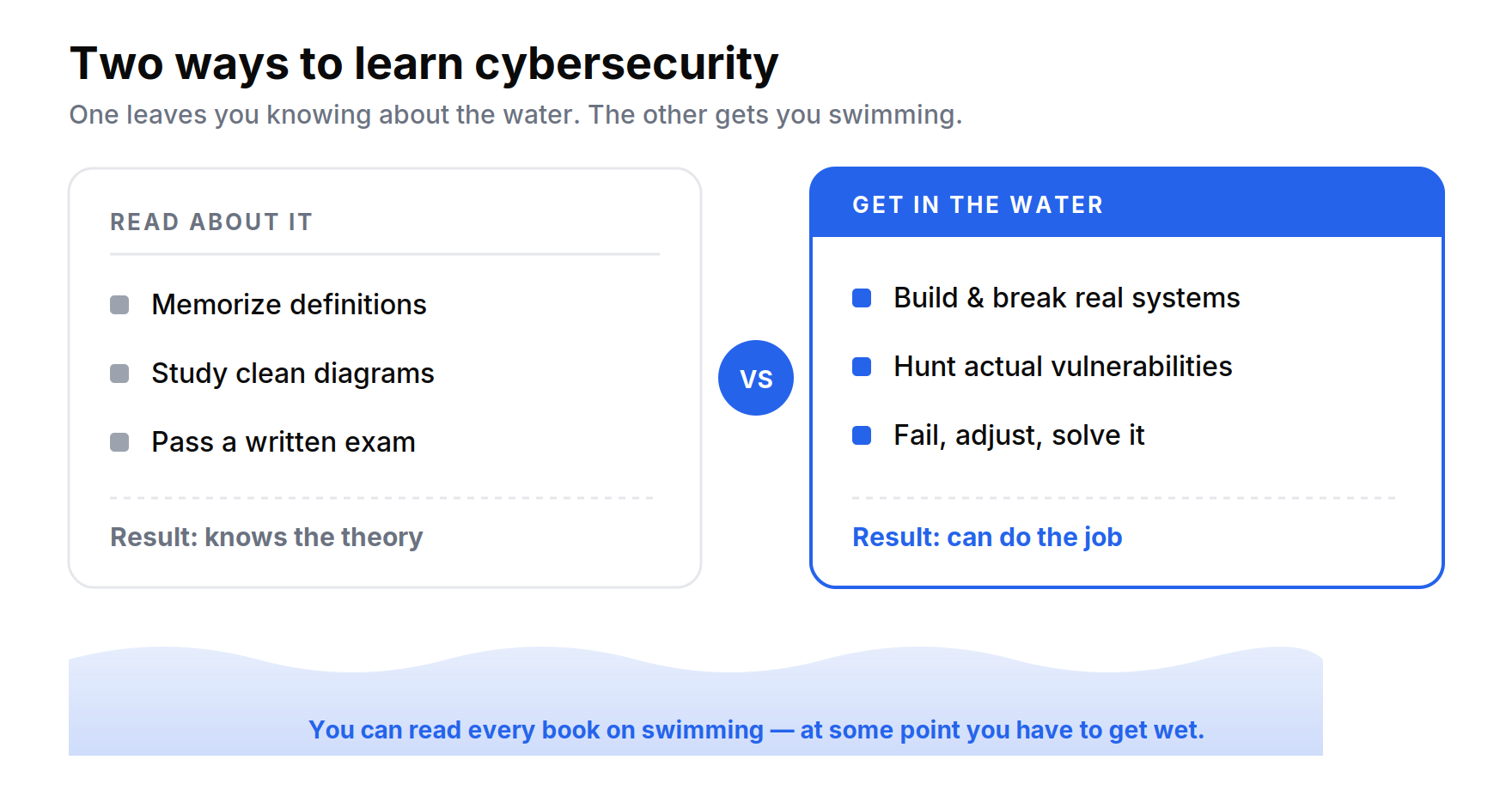
Knowledge tells you what the deep end looks like. Practice teaches you how to stay afloat in it.
Getting students into the water
The good news: you no longer need a dedicated lab, a rack of servers, or months of setup to give students real practice. Scenario-based platforms put realistic, self-contained challenges in front of learners in minutes.
Browse our scenario library, and you’ll find more than 200 challenges drawn from real-world situations. A student might escalate from a normal user to root by abusing a monitoring service running with too many privileges, defeating a web app that locks its own files away in secureArchive, or geolocating a deleted military photo using nothing but open-source intelligence. Each one is a small deep end — safe to fail in, but real enough to matter.
That variety is the point. Web security, cryptography, OSINT, privilege escalation: students rotate through the same kinds of problems professionals face, and they walk away with a portfolio of solved challenges instead of a stack of memorized definitions.
A practical path for universities
This is exactly why we built the University Cyber Cup — a three-month program that helps universities run their own Capture the Flag competitions, with templates, training, and support included. Professors get the tools to turn passive courses into active ones, and students get the experience of competing, failing, and finally landing that hard-won first solve.
You can read every book ever written about swimming. At some point, you have to get in the water. Cybersecurity is no different — and the sooner students take the plunge, the stronger they’ll be when it actually counts.
| Ready to get your students into the deep end? Explore 200+ hands-on scenarios, or bring a guided Capture the Flag program to your campus. Browse Scenarios → Apply for the Cyber Cup → |
|---|